

The WELLBY
One WELLBY is a one-point increase in wellbeing on a 0-10 scale, for one person, for one year (or equivalent).
A WELLBY (Wellbeing-Adjusted Life Year) measures how much an intervention or programme improves people’s overall wellbeing. Often, the measure used is life satisfaction.
What is a WELLBY?
When we think about transforming people’s lives, we often focus on physical health and wealth. But what about other important factors like freedom, relationships, or mental health? How do we measure these benefits in a meaningful way? This is where WELLBYs come in.
Standardised measures of health, such as QALYs (Quality-Adjusted Life Years), have been used for decades to prioritise healthcare resourcesQALYs have been researched for over 50 years and implemented in decision making since then (Spencer et al., 2022). Most prominently the UK’s National Institute for Health and Care Excellence (NICE) uses QALYs to identify whether medical interventions are cost-effective (“NICE says it generally considers that interventions costing the NHS less than £20,000 per QALY gained are cost effective and those costing up to £30,000 per QALY gained might, with certain conditions”; Ogden, 2017). This has a large influence on how the UK’s National Health Service spends (Rid et al., 2015)..
WELLBYs are a newer approachBrazier & Tsuchiya, 2015; Frijters et al., 2020; Layard & Oparina, 2021 which makes it possible to compare across the benefits or harms of a much wider set of interventions.
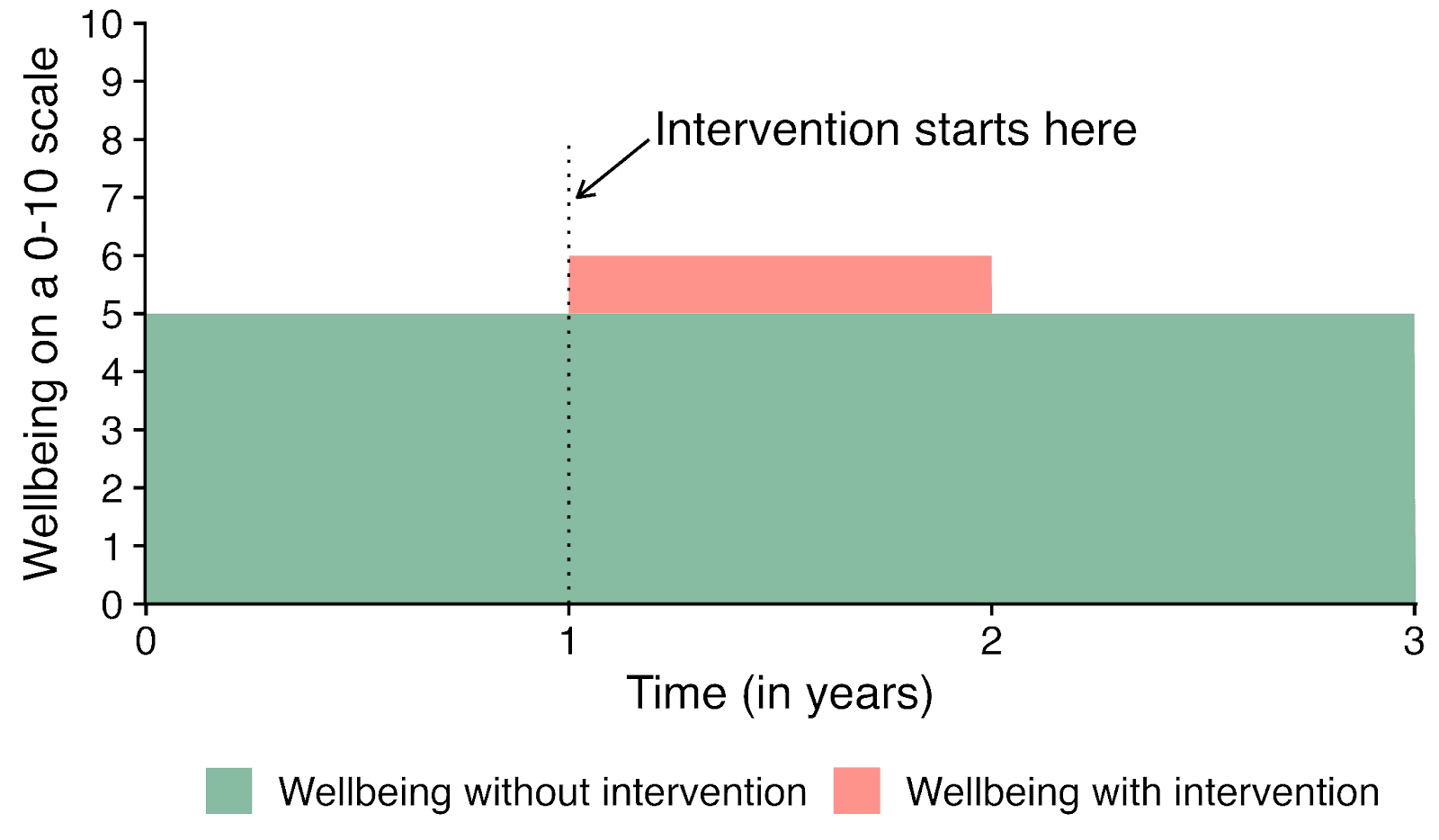
Think of it this way: if someone rates their life satisfaction as 5 out of 10, and an intervention helps them improve to a 6 out of 10 for 1 year, that’s worth 1 WELLBY for that person. 1 point × 1 year × 1 person = 1 WELLBY
How to calculate a WELLBY
Why do WELLBYs matter?
Often, we want to make people better off – for instance, if we’re giving to charity or thinking about government policy. And, we want to know if we’re having an impact – or not. This means we need a way to measure impact.
At the moment, decision makers often look at objective indicators, like health, wealth or crime rates. But these don’t capture how people feel or experience life. And there’s no easy way to compare the impact between them. Say one option treats mental health and another reduces poverty. Which makes a bigger difference?
This is where WELLBYs come in.
The full picture
They capture how interventions affect people’s lives as a whole.
People’s own voice
They let people tell us directly how their lives are going, putting their experience at the centre of decision-making.
Compare anything
They make it possible to compare different types of programmes, and so decide where to invest resources.
See what others miss
They reveal effects that health, income and education measures miss, such as social cohesion, extra leisure time or the experience of unemployment.
How do we measure WELLBYs?
WELLBYs are based on measures of ‘subjective wellbeing’ – how people think and feel about their own lives; in simple terms, these are happiness surveys. Researchers typically ask simple questions like “Overall, how satisfied are you with your life nowadays?” with answers on a 0-10 scale.
Try it yourself
How satisfied are you with your life, all things considered?
This might sound too simple to be meaningful, but decades of research show these measures are reliable, valid and comparable between people. Countries with more poverty, conflict, and instability consistently show lower life satisfaction scores, while those with better living conditions show higher scores (see the map below using the 2024 data from the Gallup World Poll – and lagging countries with missing data).
Scroll sideways to see the whole chart.
Comparing charities with WELLBYs
Let’s look at some concrete examples. The Happier Lives Institute has compared a variety of approaches to help people living in low-income countries.
Using WELLBYs, we found that some interventions are much more cost-effective than others. Some charities are 100s if not 1000s of times more cost-effective than others. This includes some surprising, potentially counterintuitive findings such as psychotherapy produced about five times more wellbeing per dollar spent than cash transfers.
Scroll sideways to see the whole chart.
Comparing policies with WELLBYs
We can draw the same kind of comparison for policies in high-income countries based on data from Frayman et al. (2024), Frijters and Krekel (2021), and various reports from State of Life.
Scroll sideways to see the whole chart.
How are WELLBYs used?
- 1970sHealth economists start using QALYs (Quality-Adjusted Life Years) to prioritise healthcare resources, as they still do today (Spencer et al., 2022).
- 2019The first wellbeing analysis of charities we know of, in Michael Plant’s Doing Good Badly?
- 2021The first analyses explicitly in WELLBYs: by Frijters and Krekel, State of Life, and the Happier Lives Institute, comparing psychotherapy and cash transfers. In July, the UK Treasury publishes wellbeing guidance for its Green Book.
- 2022New Zealand’s Treasury publishes guidance on using WELLBYs in its cost-benefit analysis.
- 2023An OECD review finds that 37 countries measure the wellbeing of their citizens.
- 2024Academics such as the LSE value for money group use WELLBYs to evaluate specific policies, and compare the cost-effectiveness of policies in high-income countries (Frayman et al., 2024).
- 2025Our chapter of the World Happiness Report 2025, “Giving to Others”, compares charities by the WELLBYs they create per dollar, drawing on analyses by Krekel and colleagues, Pro Bono Economics, State of Life and our own.
- TodayOur Living Review brings together WELLBY cost-effectiveness analyses, and our charity recommendations are built on them.
WELLBYs, summarised
WELLBYs represent a significant step forward in measuring what matters most: how much better off people actually feel. By directly asking people about their wellbeing we can better understand what truly improves lives and make more informed decisions about how to help others effectively.
Whether you are a policymaker, philanthropist, or simply someone interested in making the world better, understanding WELLBYs helps us focus on what really counts – making people’s lives genuinely better in ways they themselves can feel and report.
Give where it does the most good
Our recommended charities create the most happiness for your money, based on our own research.
See our recommended charitiesSupport our research
Help us find and share the most cost-effective ways to make people happier.
Donate to HLIUse WELLBYs in your work
If you make decisions and want to see whether WELLBYs could help you have a bigger impact, we can help.
hello@happierlivesinstitute.org