

Updates
Update to our estimates
Many of our estimates have changed since publishing this post, including the cost-effectiveness figures quoted here. For our current figures, see:
At the Happier Lives Institute, our mission is to find the charities that generate the most happiness for the money donated to them. We do this because we think happiness matters and we want to help donors maximise the philanthropic bang for their buck.
However, people are often surprised when they learn that we don’t recommend – or even evaluate – many of the large, well-known charities they recognise, such as Oxfam, UNICEF, Save the Children, or The Salvation Army.
The problem is that nearly all well-known charities are what we would call MANGOs or Multi-Armed NGOs.
MANGOs are defined as running a wide variety of programmes across many different areas of aid. These stand in contrast to FoNGOs (Focused NGOs) which run a single program in a single area of aid.
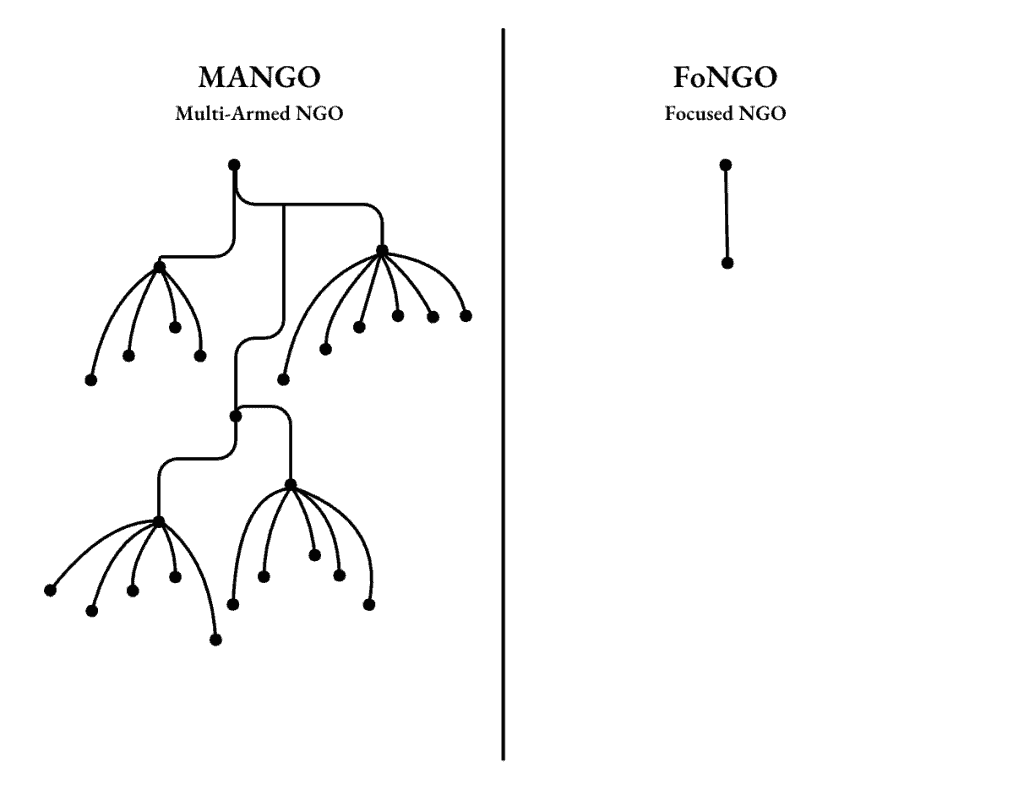
Why we don’t recommend well-known NGOs
Our goal in this article is to explain the MANGOs four core challenges that we think make MANGOs unlikely to be the most cost-effective donation choice:
- Complexity and Opacity – We can’t measure costs or impact so we don’t know cost-effectiveness.
- Dilution – Even if we could measure cost-effectiveness, mixing effective and ineffective programmes lowers overall impact.
- Fungibility – Restricted donations are often illusionary in practice. (Fungibility is when a good or asset can be interchanged with other similar individual goods or assets.)
- Mindset – Running many interventions suggests a lack of prioritisation.
Concern 1: Complexity – It’s hard to track where your money goes
Evaluating MANGOs is extremely difficult due to the sheer number of programmes they run.
For instance, according to Oxfam International’s 2022-23 annual report, they run over 1,000 programmes:
| Oxfam Intervention Area | Projects/Initiatives |
| Just Economies | 223 |
| Gender Justice | 163 |
| Climate Justice | 79 |
| Accountable Governance | 309 |
| Humanitarian Protection | 262 |
| Total | 1036 |
Focusing on a smaller affiliate like Oxfam GB or Oxfam America doesn’t help much either.
If we assume the 21 affiliates manage an equal share, that’s roughly 50 programmes each – still an overwhelming number to analyse.
Furthermore, evaluating all 656 grants they made alongside their own programmes undertaken directly would be overwhelming to us.
To put this challenge in context, we recently did the first-ever review of how much happiness different charities create per dollar – we published this in the 2025 World Happiness Report.
For that, we collected all the pre-existing wellbeing cost-effectiveness estimates – which totalled just over 20 and were generated by four different organisations over the last five years.
This means that it would take years to assess all of Oxfam’s grants thoroughly, even if we could reuse some of the existing work. And by the time we finish it, the analysis would likely be substantially outdated!
(We picked Oxfam somewhat at random to demonstrate the point as it is a very well-known charity, but these problems are present with almost any household name charity like Save the Children, UNICEF, the Red Cross, etc.)
To be clear, we are not saying these MANGOs are deliberately hiding what they do, wasting donor money, and having no impact. We expect the charities are doing good, and they don’t provide this sort of information because their donors don’t ask for it.
Many donors don’t think about charity cost-effectiveness, or believe that some charities are much better than others: they give to charities with a well-known brand name because they take that as a sign the organisation can be trusted.
What we are saying is that it’s very hard to work out how much good these charities are doing because they are so complicated, and we don’t want to recommend organisations to donors we can’t assess.
But what if we did have the capacity to evaluate all the programmes and grants a MANGO made? Would we recommend them then? Probably not. Why? Because of our next concern—the dilution effect.
Concern 2: Dilution – Bad programmes pull down good ones
As our recent chapter in the World Happiness Report examines, individual programmes can have vastly different cost-effectiveness. We find the best interventions create around 150 times more happiness per dollar donated than an average charity and around 900 times more happiness than the least-good ones we analysed.
In other words, giving $1,000 to a really good charity could do as much good as giving $150,000 to an average program and $900,000 to the less good ones!
We expect that MANGOs will probably run a mix of very good, medium and very bad programmes. This means that they are probably much more representative of the average effect of a charity – that’s not a good thing, we should be looking for the best!
To make this simple imagine you have the choice between donating to a FoNGO that runs a single, highly effective program or a MANGO that runs that same top programme alongside many others.
Since any unrestricted donations support a MANGO’s entire range of activities the overall impact per dollar donated will be diluted by the less effective programmes.
Can you get around this problem by ring-fencing your donation, that is, asking the charity to spend it just on the most cost-effective programme? This brings us to our next concern.
Concern 3: Fungibility – Restricting donations can be illusionary in practice
Ringfencing to ensure impact is not as straightforward as it seems.
Example of fungibility in NGOs
Suppose a charity has $1m in unrestricted donations and wants to fund its two programmes A and B, evenly. It had therefore planned to spend $0.5m on each programme.
You think A is much better than B though, and donate $1m, insisting it all goes to A. The charity happily obliges, putting your restricted $1m to A… then allocates the whole of its $1m unrestricted budget to B. Now both get $1m. So, the counterfactual effect of your $1m is that A gets $0.5m more and B gets $0.5m more. This is the same result as if you had just made an unrestricted donation! And of course, given that B isn’t very cost-effective, this is a loss in impact: you would rather have donated to an organisation that just runs programme A.
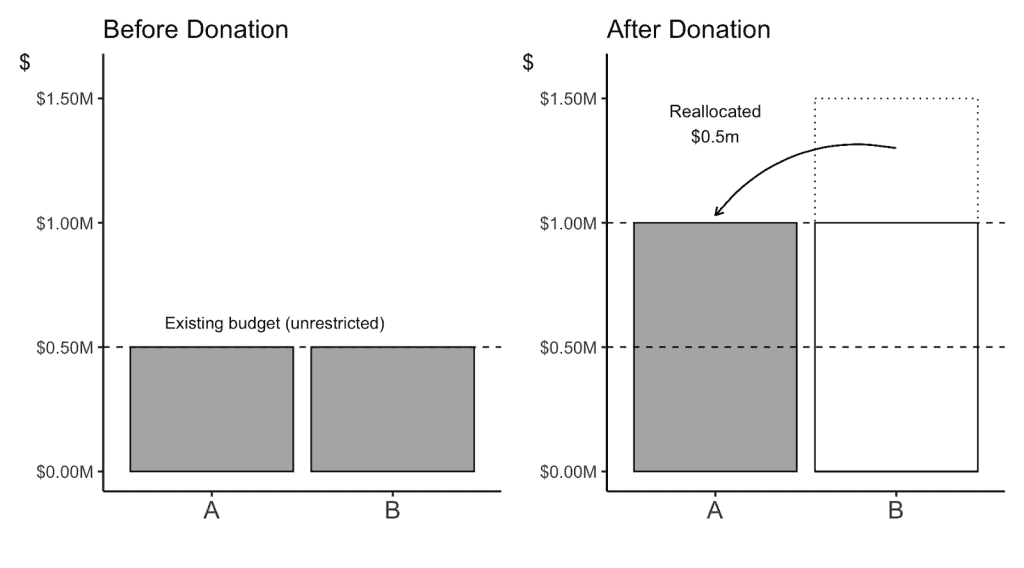
Hopefully this hypothetical example conveys the basic problem. If an organisation wants to run lots of programmes, but you only want to support one, a very likely result is that your money ends up causing more money to go to the less-good programmes.
Some eagle-eyed readers may at this stage point out that one of HLIs recommended charities, Pure Earth, runs multiple programmes with varying cost-effectiveness. We recommend a single programme run by Pure Earth – namely the removal of lead from cosmetics in Ghana. We are significantly less concerned about ‘funging’ restricted donations to other programmes run by Pure Earth for two reasons.
First, Pure Earth is not a complex organisation in the same way Oxfam is. It runs more than one programme, but it’s fairly easy for us to decipher where they spend their money and how money moves internally. Secondly, Pure Earth does not have a large amount of unrestricted funding available.
This makes it hard for them to ‘funge’ our donations from one programme to another. This gives us confidence in the counterfactual of any donation given to them. In the future, if Pure Earth grows considerably and unlocks more unrestricted funding we may re-evaluate our stance on this.
Note that this worry doesn’t apply to FoNGOs: if an organisation just does one thing, there isn’t a second programme that will get some of that funding instead.
Concern 4: Prioritisation Mindset – or, why would you want to be a MANGO anyway?
Suppose you’re the CEO of a MANGO and you suddenly think that some of the things your organisation does could be much more cost-effective than others. What would you do?
An obvious thought is you’d prioritise: you ‘prune’ the less-good programmes so you can put more resources toward the better ones and make a bigger difference.
The logical extension of this is that, if you were really serious about impact, you’d stop being a MANGO altogether: you’d prune everything until you became a FoNGO.
Wait, why have I never heard any of this before?
A natural reaction to all this is to be puzzled: if these general problems apply to the best-known charities, why has no one pointed this out before?
Frankly, we’re not really sure. Even though we’ve been thinking very hard about charity cost-effectiveness for years, including learning from those who came before us, it hadn’t clicked until we came to write the chapter for the World Happiness Report.
For that, we reviewed all the existing work assessing charities by wellbeing cost-effectiveness. All these estimates were of FoNGOs, because those are easier to assess.
We realised a major omission in our global review was it didn’t include any big, well-known charities. When we tried to assess big charities, we noticed what made them hard to assess wasn’t that they were big per se, but that big charities are almost always multi-armed, and there were various problems that came with the ‘multi-armed-ness’.
Are larger multi-armed charities always less effective than smaller charities?
Our criticisms of MANGOs should not be interpreted as a blanket rejection of large or multi-armed charities.
For example, one large charity we like is GiveDirectly, which had nearly $140 million in revenue in 2023. Despite its size, GiveDirectly operates only one type of programme: unconditional cash transfers. To use our terminology, this makes it a FoNGO. This means donors can be confident that every dollar they contribute directly supports a well-evidenced, high-impact intervention. We expect that GiveDirectly is among the most cost-effective charities in the world, but we have identified other charities which are even more cost-effective, but also much smaller.
Similarly, multi-armedness is not always an insurmountable problem. Naturally, if a MANGO demonstrates transparency for their programme costs and impact and a focus on the most impactful programmes, then they could indeed be a very cost-effective organisation.
A multi-armed organisation we admire is Pure Earth, which runs multiple programmes focused on reducing lead exposure. We think of Pure Earth as somewhere between a FONGO and a MANGO, but it fits the MANGO description given our current terminology. Its programmes are quite varied, ranging from research, cleaning up toxic waste sites, to advocacy and technical assistance to remove lead in cosmetics, paint, and spices. However, their focus on lead exposure allows them to internally compare the cost-effectiveness of different programmes depending on their effect of reducing lead exposure as measured by the particles of lead found in blood.
We think other multi-armed NGOs that are known to have highly cost-effective programmes are still relatively focused and have more like a dozen rather than hundreds of programmes (e.g., Pure Earth, Evidence Action, Helen Keller International).
Setting these examples aside, we think there are some potential advantages to being a MANGO.
- Allows risk-taking on innovative programmes.
- Scale successful solutions.
- Talent recycling and solving coordination problems.
- Reduce oversight costs for institutional funders
1. Allows risk-taking on innovative programmes. A MANGO, in principle, due to their larger size (and potentially deeper pockets), can afford to take on some programmes that end up being failures. This mirrors an argument that large companies can afford to take on long-term horizons and invest in innovation, whereas smaller companies have to fight over margins. However, we think that FONGOs are more like start-ups, and much more innovation in the recent past has sprung from them in the charity and for-profit spheres.
One noteworthy exception to this might be Evidence Action, who constantly try small-scale projects and scale successful ones. Crucially, though, they are willing to drop programmes even once scaled in the face of new evidence that they are not having the impact they had hoped.
For example, in 2019, they famously closed down their No Lean Season programme, which gave seasonal migration subsidies after an RCT in 2017 indicated it was having the intended benefit.
However, this argument only applies if the MANGO is running programmes as experiments, then shutting down the bad ones. It doesn’t apply to organisations that keep running lots of programmes.
2. MANGOs can scale successful solutions. A potential benefit of a MANGO is that it should have the operational infrastructure to scale promising programmes. However, our concern here is related to the 4th concern. If MANGOs are innovating and creating vastly better programmes (and they know it!) we’d expect to see large reallocations of funding from old to new programmes. We haven’t seen this, but if you have, please correct us!
3. Complex problems need coordinated solutions – but most MANGOs aren’t built for it
Many development problems are messy and cross-cutting. Solving them well sometimes takes multiple disciplines working in sync. In theory, MANGOs are well placed for this – they’ve got teams across sectors, and they could combine interventions in clever ways. MANGOs that have expertise in different cross-cutting areas like gender, climate and peacebuilding can bring cross-cutting support to different programmes by having some ambitious programmes that focus on transforming gender equality, for example, and others where it is integrated but not the primary focus of the programme. Having this in-house expertise from running programmes allows activities to be ‘sensitive’ to cross-cutting priorities and intersectional, so that programmes can, at least, not exacerbate conflict, gender equality or climate issues, and at best, have a transformational effect on them.
But in practice, we rarely see evidence that their interventions work better together than they would alone. Without proof of synergy, running 50 things at once looks more like mission creep than impact maximisation.
It could also be cheaper for one group to provide a service than several (think GiveDirectly at scale), but that’s an argument for scaling a single intervention, not for throwing everything into one mega-org.
We’re also curious whether nimble, focused FoNGOs could coordinate across orgs to solve complex problems, without becoming bloated themselves. It’d be hard, but maybe worth trying.
4. Reduce oversight costs for institutional funders. One of the reasons we think MANGOs might exist is to solve a problem for the largest funders. It’s easier for an institutional funder like the UK government (say, formerly DFID, now FCDO) to only deal with a few organisations that already have working and trusting relationships with. It’d presumably take considerably more bureaucracy to evaluate the hundreds or thousands of FONGOs than it’d take to deliver the same programmes as a single MANGO may. This also simplifies reporting on the part of the MANGO. Indeed, it’s possible that even if we can’t see their impact data, it might exist behind closed doors for the largest funders. While we think this could be a reasonable arrangement for the largest funders (although we think they should also prioritise cost-effectiveness!). This potential advantage also doesn’t imply that MANGOs are a reasonable choice for small donors. Small donors can consult charity evaluators (like us) to see which charities are the best buys for wellbeing.
The reason we aren’t swayed by these considerations is that these are advantages in principle. If these actually led to more cost-effective programmes, it lies with the MANGO to demonstrate this – something we rarely see in the public domain. While MANGOs might have some natural advantages, our concerns lead us to think we shouldn’t give them the benefit of the doubt. If they have so many natural advantages, we would hope they would leverage them to show they’re better charitable investments.
Moreover, these potential benefits do not overcome our current concern with some of the largest household name MANGOs – namely, they are too complex for us to evaluate. If we cannot be sure of how donor money will be used, we are unable to recommend a charity.
Conclusion: Don’t let the brand name fool you
The sad truth is that most well-known charities are MANGOs – multi-armed, complex, and nearly impossible to evaluate. That doesn’t mean they’re doing harm, but it does mean we can’t tell how much good they are doing. And when the difference between an average programme and a great one can be 140-fold, that ambiguity matters – a lot.
So if you care about maximising the impact of your donations, the smart money isn’t on the biggest names. It’s the best data. And right now, that data points toward small, focused charities running high-impact programmes we can evaluate.
In other words, beware the MANGO… it might just turn out to be a lemon.