

Updates
Update to our estimates
Many of our estimates have changed since publishing this post, including the cost-effectiveness figures quoted here. For our current figures, see:
How much better are the best charities to donate to compared to the average charity? And how much better do people think they are? The Happier Lives Institute presents new evidence-based answers to both those questions.
How effective are the best charities to donate to?
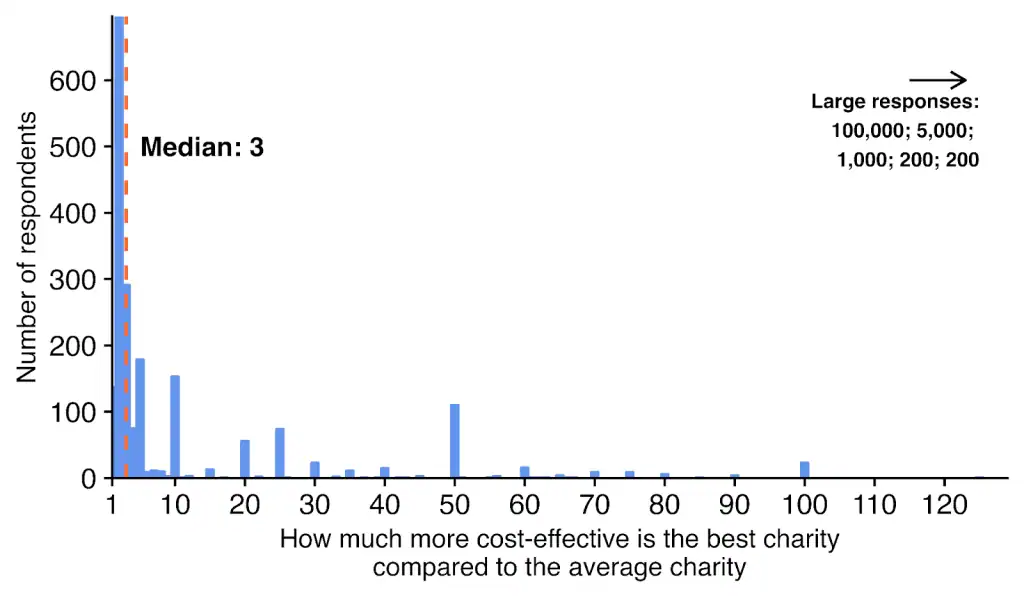
Let’s start with the expectations around the best charities to donate to. We asked a representative sample of the US population through the platform Prolific. Prolific generously allowed us to add a question asking people what they think the difference is between the best and average charities in terms of happiness per dollar donated. This found people believe the best charity is x3 better than the average charity.
What’s the reality? In our recently published chapter in the World Happiness Report, we conducted the first global review of charities. We looked at how much happiness different charities create per dollar.
We found that the best charities to donate to globally are about x1000 better than the typical charity in a high income country like the UK.
Specifically, the ‘best charities’ was the average of the top five charities.
This means that if you donate $100 to one of the best charities, you are doing as much good as donating $100,000 to a typical charity.
What this means is people vastly underestimate how much better the best charities are – by a factor of over 300 times!

We think addressing this perception is important: if you think the best charities are only slightly better, why worry about what you pick? This allows us to say that people underestimate, by a large amount, how much more good they could be doing with their charitable giving.
Read on to discover our collaboration with Prolific and our review of charity cost-effectiveness.
Measuring expectations of the charity cost-effectiveness
Prolific is a platform that allows researchers to collect high quality data from a large, global pool of respondents. They also run monthly polls on representative samples of the US and UK. In April, they surveyed a representative sample of 1,999 Americans.
The Happier Lives Institute is proud to partner with Prolific to include a question in this month’s poll. This is what we asked:
“Some charities are more cost-effective than others. Cost-effectiveness (in our example here) is measured by the amount of happiness created. With the same amount of money, a more cost-effective charity can create more happiness than a less cost-effective charity can. Among all charities:
- Charity A has the highest level of cost-effectiveness
- Charity B has an average level of cost-effectiveness
How many times more cost-effective do you believe Charity A is compared to Charity B?“
Five respondents gave really large responses (x100,000; x5,000; x1,000, x500, x200 as cost-effective). But the majority of responses were much smaller128 respondents answered ‘0’, but it is not possible for the best charity to be less cost-effective than the average one. So we removed these, ending up with 1,971 responses..
We find that the median2We use the median because the responses include many small values and a few very large values. The median is not affected by the few large values like the mean would be. This is the same methodology used in previous research on this topic (see the end of this blog). respondents think the best charity is x3 better than the average charity. But, as we mention further down, this is far from the truth.
For more from this month’s Prolific poll – for example approval levels of Trump’s tariffs – read the full results. You can also find the data and code for this analysis on our GitHub.
The best charities to donate to are far more different than most people think
So, what do we actually know about differences in the cost-effectiveness of charities?
Our own research at the Happier Lives Institute reveals even more dramatic differences. Our recent chapter in the World Happiness Report 2025 is the first global, empirical review of charity cost-effectiveness; the charities were assessed according to their impact on wellbeing per dollar.
Our work shows that the very best charities evaluated are not just slightly more effective, they are hundreds – even thousands – of times more effective than more typical charities.

The best charities to donate to: key takeaways
- The top five charities we evaluated are around x1000 more cost-effective than typical UK-based charities.
- The most effective charity evaluated to date, Pure Earth, is approximately x916 more effective per dollar than the least effective charity that had a full evaluation, Football Beyond Borders (which operates only in the UK).
- When compared to our quick calculations done for more common charity choices such as guide dogs or homelessness interventions, the difference grows even more dramatic: Pure Earth is roughly x3300 more effective per dollar spent.
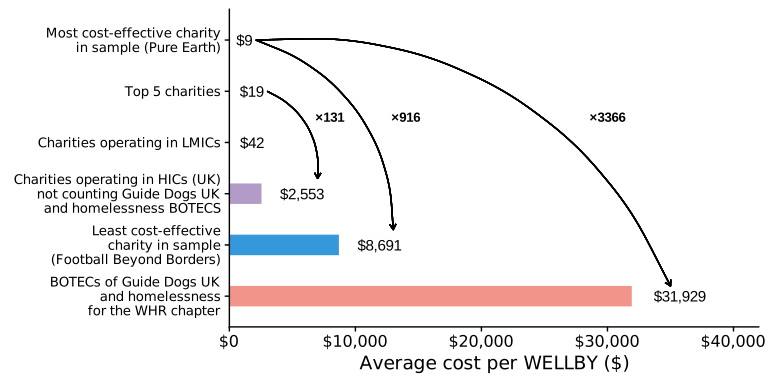
This size of the difference should be shocking – it’s far greater than the 3 times more that most people guess. It shows how critical choosing your charities wisely can be if your goal is maximising happiness in the world.
Why should we care about the actual best charities to donate to?
Why should we care about this discrepancy between perception and reality? Because it directly impacts how effectively we help others. When people underestimate the difference between charities, they have less incentive to seek out the most effective options. Informing people about these real, vast differences could significantly boost effective giving.
Caviola et al. (2023) found that when people learned about the true scale of these differences, they significantly shifted their donations toward more effective charities. Correcting this misconception doesn’t just change minds; it can profoundly improve the lives of many, many, many, many, many more people.
Our results are consistent with previous research findings
Our collaboration with Prolific builds on earlier research by Caviola et al. (2023) in the US. We use a very similar question to theirs (see Experiment 1 ‘explicit comparison’), slightly modified.
The primary difference is that we removed the reference to charities serving the world’s poorest, changing the implied reference to any charity operating anywhere. We also said that cost-effectiveness is measured by the “amount of happiness created” instead of “the number of lives saved”.
Why did we ask such a similar question?
Well, firstly because replicating findings is an important part of research (the Prolific poll is a much bigger sample size!). Secondly, the framing that Caviola et al. used was narrower. They focused on the differences for charities that “help the world’s poorest” and defined cost-effectiveness “by number of lives saved”. That’s a relatively narrower framing than any charity in general, and doesn’t mention improving the quality of life (increasing happiness or wellbeing). These differences might explain why we find a slightly different result.
Caviola et al. found that the general public (n = 368) estimated the best charities at saving the lives of the extreme poor to be about x1.5 better than average charities working in the same area. In contrast, experts (n = 45) in charity evaluation estimated that the most effective charities could be around x100 more effective than average charities addressing global health and poverty. A similar poll to the Caviola et al. one except focusing on global health (and not just saving lives)3The wording of the question was “For this question, focus on interventions that charities might use to improve global health (e.g., giving vaccines or clean water). How much more effective do you think ‘highly effective’ interventions are, compared to the average interventions? For the same amount of money, ‘highly effective’ interventions produce outcomes that are ___ % better?” (p. 16). found that Australians thought the best global health programme was x1.44 better than the average one (Graham et al., 2024; n = 1,059).

These vast discrepancies suggest a profound gap in understanding about charity effectiveness.
The best charities to donate to
Your choices about where to give are powerful. Knowing the truth about charity effectiveness can transform how you donate. Here are some ways you find the best charities to donate to:
- Donate Effectively: Support charities proven to maximise happiness per dollar.
- Learn More: Explore our detailed analysis by reading our chapter in the World Happiness Report 2025. You can also learn more about Prolific’s polling.
- Donating to the Happier Lives Institute: Our research costs time and money! If you want to support the Happier Lives Institute to keep shining the spotlight on fantastic charities.
- Staying informed: Sign up for our newsletter to receive updates and insights into effective giving opportunities.
- Spread the Word: Share this information with others who care about making a difference.
Together, we can bridge the gap between perception and reality, turning good intentions into effective outcomes.