

[This is the second of two articles on the relationship between happiness and money. The last covered whether money can buy happiness – we said ‘yes, with minor caveats’. This considers how to buy more happiness for your money.]
Part of our frustration with the “can money buy happiness?” debate is that it obviously matters how you spend the money – and this is left out of the discussion.
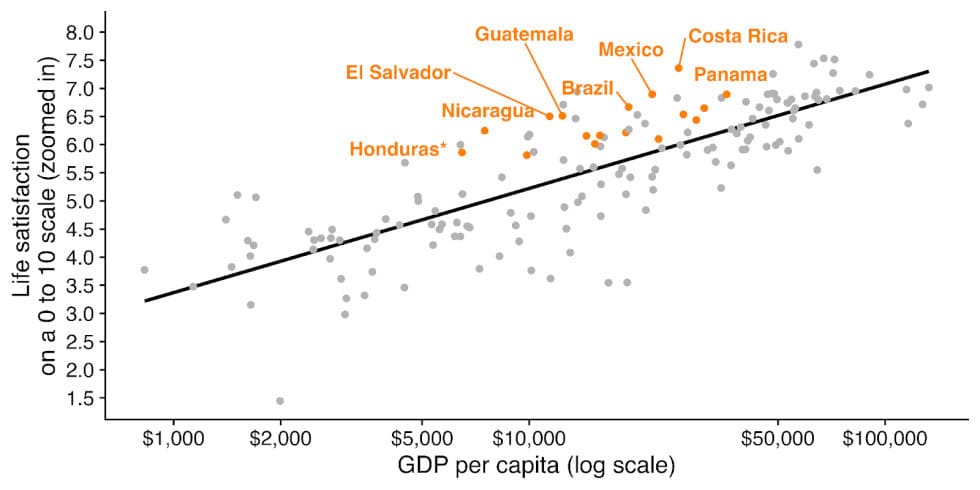
As we’ve pointed out before, some countries (particularly those in Latin America) seem to be way better at buying more happiness for their money. An even more extreme version of this comes from a study that found that many small scale societies (think modern hunter-gatherers / pastoralists) are just about as happy as inhabitants of rich countries despite living below the global extreme poverty line.
So what should you invest in if you’re trying to buy the most happiness? Well, there are two questions with mostly different answers. Are you just trying to buy happiness for yourself? Or, are you thinking altruistically and trying to buy happiness for others? Let’s take these in turn.
1. The generic advice holds:
- Whatever you can do to invest in relationships is probably worth it. Loneliness is one of the key predictors of misery, sometimes even more than the presence of depression. Now, you probably can’t easily spend money to make friends and find lovers. A more common situation is that we can give up working a bit more (and making a bit more money) for more time with our family and friends.
- Sleep quality is on par with income as a predictor of happiness. Buy some air conditioning (I’m speaking specifically to the Europeans amongst us), a better mattress, or get help via an app or a professional with the gold standard for treating insomnia: cognitive behavioural therapy.
- Get some exercise. Some studies have found that activities like walking, running, or dancing are comparable or better than traditional treatment for depression. While buying something like a gym membership rarely works, if you really have the money, investing in something that would increase your accountability (e.g., a trainer) could be a wise choice.
2. Some less common advice is also worth stating:
- Cultivate cheap tastes. This is less of a specific call to action, and more a granting of absolution. There’s often considerable cultural pressure to have “fine” taste and to appreciate expensive wines or the difference between a $100 and $1,000 watch. This is, in my view, pretty stupid. Instead of letting yourself think of what you like as “cheap taste”, consider it “cost-effective taste” 😎. This is in line with the classic advice from a group of psychologists to buy many small pleasures instead of a few large ones.
- Thankfully, this advice is becoming more common, but get mental health help if you need it. Mental health is one of the most important determinants of happiness. Therapy works. Critically, it’s unexpectedly good, so it probably works better than you think. It also doesn’t really matter the format, it can be group or individual, online or in person – you may not even need a (fully trained) therapist. And here’s a secret psychologists don’t want you to know (psychologists hate him): the effectiveness of a lay counselor is comparable to a fully trained professional. Even self-guided interventions work (although some guidance is better). Experiment, find out what works for you.
- Go towards the light: Most of us living outside of the tropics don’t get enough light in winter. Thankfully, light has become incredibly cheap. My guess is for winter most of us would be better off with more light. You can buy more lamps, higher luminosity bulbs, or lamps especially made to treat seasonal affective disorder (SAD, AKA the winter blues). While exposure to more light is a known treatment for seasonal affective disorder, it also increases wellbeing generally and has been shown to improve depressive symptoms in non seasonal cases.
- Clean your air. Air pollution (in pretty much all forms, but especially small particles) is really bad for physical and mental health. Thankfully, air filters can reduce the deadliest form of particulate matter by 60%. They’re also not particularly expensive, basically being a fan attached to a fine mesh. We haven’t done an analysis of best buys for personal wellbeing but I would guess that air filters would come out pretty high. Oh, they can also probably reduce the transmission of pathogens.
- Help others. It’s a well-established and replicated finding that giving to others makes you happier. As we argued in a previous post, we’re way too quick to say the solution to all our problems is to focus even more on ourselves. Indeed, helping others isn’t just good for us, it’s unexpectedly good. This is one area that irritating marketing types would call a ‘win-win’ because giving is good for you and good for others. If you don’t believe us, try it and find out!
Buying happiness for others
Figuring out how to turn money into the greatest happiness for the world is the reason we exist.
Our conclusion, after 6 years of research, is this: the best charities are hundreds, even thousands, of times better than others.
If you gave $1,000 to one of these charities, it could be as much good as giving $1m to another. This is not what people expect. Research, by ourselves and others, shows that people think the best charities are 1-3 times better than the average. We’re able to make this big claim because we did the first ever global comparison of charities. This was published in the World Happiness Report and we reviewed all the work so far that has estimated how much happiness different charities create per dollar. So, we’re not only saying money can buy happiness, we’ve looked for the ‘best buys’ for creating happiness for other people.
So in short, if you want to buy the most happiness – give to the highest impact charities. We’ve spent hundreds (probably thousands) of hours doing academic style research to find the best charities at increasing happiness.
The best charities for improving happiness per dollar are:
- Funding advocacy and technical assistance reduce lead exposure in children (Pure Earth)
- Treating acute malnutrition (Taimaka)
- Using therapy to treat common mental health disorders (Friendship Bench, StrongMinds) and reduce crime (ACTRA).