
While we often say “money can’t buy happiness”, we sure act as if it does. We take improving material prosperity as a key goal, not just in our own lives, but also for our societies. But how much do we really know about the relationship between money and happiness? When does money make us happier, by how much, and in what circumstances? That’s what this series of essays will be digging into. Hopefully, deeper than ever before.
I would have thought there would be a good overview of this topic for readers. There’s certainly been a swelling body of academic work taking wellbeing seriously1See Barrington-Leigh for a more careful analysis of growth in the wellbeing literature (2022).

But I tend to see the same narrative recycled in popular discourse when it comes to wealth and wellbeing. The narrative comes in one of two forms. The first is more focused on the individual, and you’ll see it more often in pop-sci2The likes of which have all melded into an indistinguishable amorphous blob that resists the dissection of my frail memory.:
It goes something like this: “People used to think lottery winners were no happier than anyone else, based on a small 1978 study. But much larger Swedish lottery data found lasting gains in life satisfaction. And remember that happiness supposedly stops rising at $75,000 a year? That figure, from Kahneman and Deaton (2010), was famous enough to inspire one CEO to raise his whole company’s minimum salary to $70,000. But this finding was later challenged, and then the authors, in a heartwarming display of academic integrity, worked together to reconcile their differences.”
The second narrative is more about countries:
“Look at this graph: life satisfaction is strongly related to GDP per capita internationally. Makes sense, right? But this only captures countries at one moment in time. What happens when they get richer over time? For a while, the consensus was that countries didn’t get happier as they got richer, a surprising result known as the Easterlin paradox. But then one clever paper seemed to settle the debate: countries getting richer do in fact get happier.”
This second story paraphrases the position taken by Steven Pinker in Enlightenment Now, by Jason Crawford in his writing on the topic, and to some extent by Scott Alexander in his debates on income and happiness – although Scott does an unusually good job conveying much of the weirdness and grandeur I see in these questions.
Both narratives tend to scratch the surface. Each one rests on a handful of headline studies, while hundreds of papers full of interesting and puzzling nuance remain unexamined.
The problem, as I see it, is that there are few3Here are some of the best overviews I’d reference: – The Our World in Data page on Happiness and Life Satisfaction provides an accessible surface-level introduction to some of the main topics. – Wellbeing: Science and Policy by Baron Layard, and Jan Emmanuel De Neve (2023); or A handbook for wellbeing policy by Paul Frijters and Christian Krekel (2021). These books provide broad overviews, but they are textbooks, which limits access. Second, they provide an overview of the whole field, but when discussing the relationship between income and wellbeing, they still discuss a handful of studies. There have been hundreds of studies on the topic, with many in complete disagreement with one another. I want to know who is right, and why., if any, in-depth and accessible reviews of some of the greatest controversies around what I think is one of the most important questions in social science: when and how does money make us happier?
So, why is there such a gap between the popular and scientific discussions? Partly, this is a general problem with science. But I think the problem is worse for topics like this one, which sit close to fundamental questions of life, the universe, and everything – things like consciousness, creation, and what it means to live the good life. Most people have some stake in these debates, so there’s a tendency to mass-produce quick, simple answers. The result is that the literature on money and happiness is treated something like an intellectual tourist site: widely visited, sparsely inhabited, with attention monopolised by a few key attractions. What’s out there is what I imagine you’d get from seeing Venice by spending a couple of afternoons at the Piazza San Marco and the Doge’s Palace. Fine as far as it goes. But I’m aiming for something more like a slow tour of the lagoon’s lesser-known historical islands as well. Or, to strain the analogy a bit, the four-hour podcast deep-dive version of Venetian history4Note, I’d highly recommend the book Venice A New History by Thomas F. Madden, which argues that Venice was a true Republic not a shadowy oligarch, the real defender of Christendom (unlikely cowardly and tyrannical Genoa), and that the whole thing that happened with the fourth crusade and sack of Constantinople wasn’t as bad as it seemed and maybe the Byzantines had it coming anyways..
To deepen the discourse, I’m planning to review the evidence related to the following questions I think are either unasked or haven’t received the attention they deserve:
- What is the magnitude of the association between income and wellbeing? This should be a simple question. But when this recently came up, my colleague and I gave answers that differed by 4x; I realised we shouldn’t be so confused. Knowing these sorts of things should be our job, and the priority placed on increasing incomes varies quite a bit depending on where the true value falls within this range!
- Should we expect a doubling in income to have the same effect for rich and poor alike? The standard assumption is yes. But while this assumption has very nice mathematical properties, it is mostly just that, an assumption. What does the data say? What would it mean for policy and philanthropy if every doubling had declining, or God forbid, increasing returns to wellbeing?
- What is the causal effect of income on wellbeing? This is one of the biggest gaps in the literature. While I would expect this to be one of the first places to go to answer the question of wealth’s impact on wellbeing, most discussions involve correlational evidence. This was likely because, for a long time, we didn’t have strong causal evidence. Now we’re approaching or surpassing ~100 natural experiments and RCTs that directly test the relationship between income and happiness. Especially given discussions around the potential panacea of UBI, it feels like a good time to review the effects of lotteries, cash transfers, and income policy shocks on wellbeing outcomes.
- Does economic growth make us happier? A surprising share of the wellbeing science field thinks the answer is “no”, which is the basis of the Easterlin Paradox. There is no authoritative review of this debate. I still see people citing the 2008 Stevenson and Wolfers paper as a definitive settlement of the issue, even though nearly 2 more decades of data and analysis have come out. Have the ensuing decades changed the picture? I intend to find out! Luckily, I know a fair number of participants in this debate, so I’ve started reading and summarising many papers and interviewing the researchers most involved. If economic growth didn’t make us any happier, this would be strange but profoundly important to know!
- If economic growth doesn’t make us happier, what does? A lot of attention goes into whether economic growth explains changes in happiness. But country-level average happiness moves around quite a lot, and there’s been surprisingly little interest in, or analysis of, what (else) explains the changes over time. Some candidates are social capital and trust, or welfare spending. How good is the evidence, what are the best predictors of progress in wellbeing, and how do they compare to GDP growth?
- What does literature about national wellbeing progress say about how happy our ancestors were? I expect that most wellbeing models would predict (even for reasons beyond GDP) that our ancestors were pretty miserable. But small-scale societies seem suspiciously satisfied, reporting average satisfaction levels similar to some of the richest, most satisfied countries in the world (Galbraith et al., 2024). This seems strange and worth investigating.
I also aim to explore several puzzles that lie near the intersection of wealth and wellbeing, such as:
- Is anxiety the dizziness of financial freedom? Some evidence suggests richer societies are more satisfied but also more anxious (Ridley et al., 2020). That’s weird. Typically, measures of mental health and mental wellbeing go hand in hand. Is this a quirk of measurement, mental health stigma, or a reflection that modernity might come with some special maladies?
- Are young people increasingly sadder? And if so, is it any of the usual suspects: the internet, phones or social media? These are questions at the heart of an ongoing debate about social media and the mental health of young people, which is widely proposed as a case where technological progress and prosperity have allegedly left many of us worse off (e.g., Haidt, 2024). I’ll try to determine whether the causal evidence supports such a conclusion. Teaser: so far it seems like social media is bad.
- Is it the psychology, stupid? Does any of this research on wealth and wellbeing help explain the populist moment, and why so many societies are materially better off but their politics feels increasingly dominated by fear and anger?
Maybe you find these questions self-evidently fascinating and worth pursuing. Maybe, like me, you crave the answers. But if you don’t (yet), I want to share the three puzzle pieces that most inculcate in me the sense that there’s something curious, strange, and potentially important in wealth’s relationship to wellbeing.
- We are far richer than we ever were, and seemingly no happier.
- We see progress on almost every measurable good, except happiness.
- Given one and two, could this explain why our politics is such a dumpster fire?
1. But are we happier?
“If we have a shred of cosmic gratitude, we ought to be. An American in 2015, compared with his or her counterpart a half-century earlier, will live nine years longer, have had three more years of education, earn an additional $33,000 a year per family member (only a third of which, rather than half, will go to necessities), and have an additional eight hours a week of leisure.”
– Steven Pinker, Enlightenment Now (the beginning of the happiness chapter).
As Steven Pinker points out after the quote, Americans are exceptionally unmoved by the rising tide of material progress. If they’re grateful, we don’t see it in the data. And Americans, in this regard, are not exceptional.
While many countries have gotten richer and happier, if you zoom in on the richest countries, many have gotten richer but no happier.
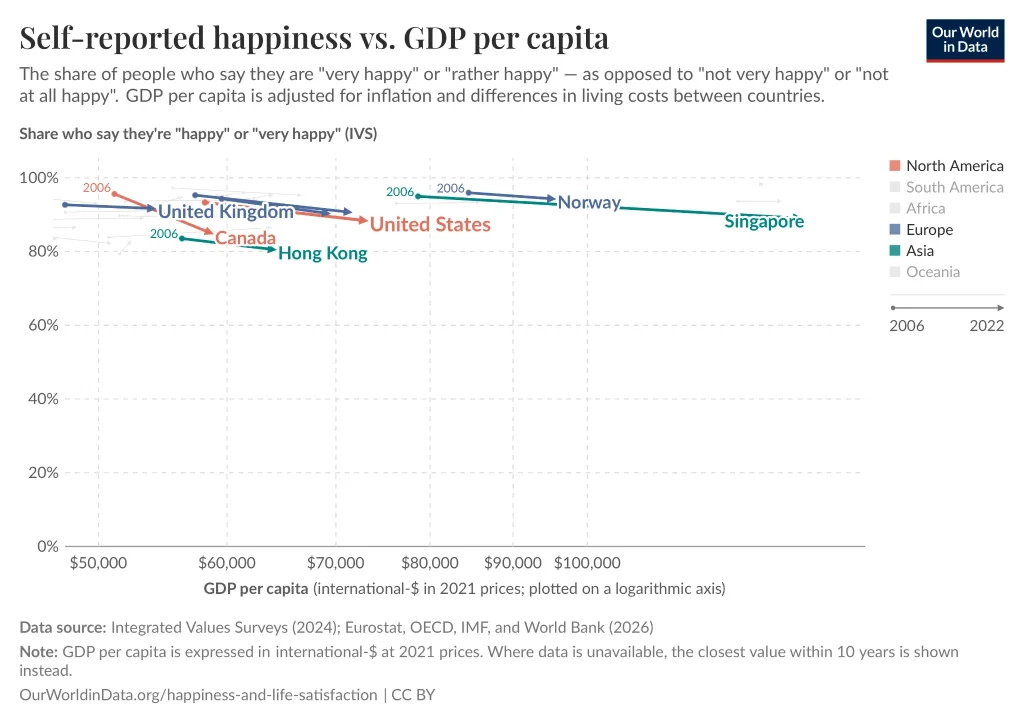
The case is clearest in the USA, which also has some of the longest-running datasets measuring mental wellbeing. Across most of the major surveys, there’s a consistent trend of people reporting feeling less satisfied, happy, and emotionally well, especially after 2020 (Peltzman, 2026); the same is true for measures of mental distress (Ruhm, 2026). While millennials may be blinded by nostalgia when they say things were better in the 90s, there is at least some evidence that suggests they may be right.

Note on this figure in the footnotes5This figure was made with the help of Claude using data from the Gallup World Poll, World Value Survey, General Social Survey. The GSS asks “very happy / pretty happy / not too happy” in every round, but in the 2002, 2012 and 2022 ISSP modules the same respondents were also asked a 7-point happiness question (happy7, completely unhappy … completely happy). We rescale happy7 linearly to 0–10 and then give each 3-point category the weighted mean happy7 score of the people who chose it, among the 3,540 respondents who answered both: not too happy = 5.76, pretty happy = 7.36, very happy = 8.62. The mapping is therefore empirical rather than equally spaced (the linear alternative is 0 / 5 / 10). The steps are 1.60 and 1.26 points, and every category sits well above the midpoint, because most “not too happy” respondents still place themselves at “neither” or “fairly happy” on the 7-point item. Two caveats: the 0–10 target is a rescaled 7-point happiness item, not a life-satisfaction score, and a conditional mean shrinks categories toward the overall mean, so this mapping understates the differences between categories. An alternative chain spreads them further, to 4.67 / 6.86 / 8.33. It matches GSS categories onto WVS/EVS happiness categories using US response shares, then scores each at that category’s mean 0–10 life satisfaction., where, inspired by Matt Clancy’s similar graph, I took an unconventional but hopefully more evidence-based approach to translating the GSS to a 0 to 10 scale.
One response I expect when looking at graphs like this is to concede that yes, it does seem like there’s perhaps a negative trend in some of these surveys, but to press on its significance: is this really a large effect? What is it, a 0.25 to 0.5 point decline on a 0 to 10 scale? My response is that this is a sizable decline by noisy national standards. It means that the USA has fallen from being ranked as high as 11th in 2012 → 23rd in 2026 (Helliwell et al., 2012; World Happiness Report, 2026), it’s similar in magnitude to the benefits of marriage (Stutzer & Frey, 2006) or the fallout of divorce (Lucas, 2005), comparable to effects of long-term exposure to the Chernobyl disaster (Danzer & Danzer, 2016); half the effect of unemployment (Deaton, 2012; Stutzer & Frey, 2006), or a quarter of the effect of the collapse of communism (Guriev & Zhuravskaya, 2009; Easterlin, 2009). A decline from 7.25 → 6.75 would be about a 10% drop in someone’s wellbeing, assuming wellbeing becomes negative below ~2.5 on a 0 to 10 scale (Dupret & Plant, 2026).
This seemingly substantive decline in wellbeing is despite, as Pinker pointed out in the opening quote, Americans reaching an unparalleled age of material plenty across nearly every conceivable material dimension. The rabbit hole deepens with the deepest declines in happiness sometimes coming from segments, like women, that have seen more objective progress, illustrated by women’s improvements in wages, declines in the wage gap, increased ability to participate in the labour force, and higher educational attainment (Stevenson and Wolfers, 2009).
This paradox of decline is further sharpened by the position we seem to inhabit, where we sit on the precipice of what many expect is an economy transformed by AI, potentially bringing about an unparalleled age of abundance. Yet, even economists expect that in a high-growth AI scenario, US life satisfaction will fall by roughly 0.2 points on a 0 to 10 scale (Karger et al., 2026), comparable to a moderate recession (De Neve et al., 2018).

Note: Figure from Karger et al. (2026).
I think this provides the essential spark of the problem, and is the barb my mind seems hooked on. It would be a strange world if, to paraphrase Robert Solow, you could see progress everywhere but in the happiness statistics6Of course I am paraphrasing the Solow quip that you can see the computer age everywhere but in the productivity statistics..
2. Progress: the wrinkle of wellbeing
Almost every measurable good (health, longevity, literacy, material comfort) goes unambiguously up and to the right.

Happiness seems to be a sad exception7This is based on Gallup World Poll data, which is the most comprehensive global dataset. The next most comprehensive is the combined World Value Survey and European Value Survey, which shows a bit more positive trend. But the coverage isn’t quite as good or consistent across time, so I’m less sure that the trend is capturing a genuinely conflicting and more optimistic signal or whether it’s confounded by compositional changes in countries across time. I’ll try to return to this mystery later.. However, some forecasts predict a slightly brighter future consistent with continuing recent trends in global satisfaction.
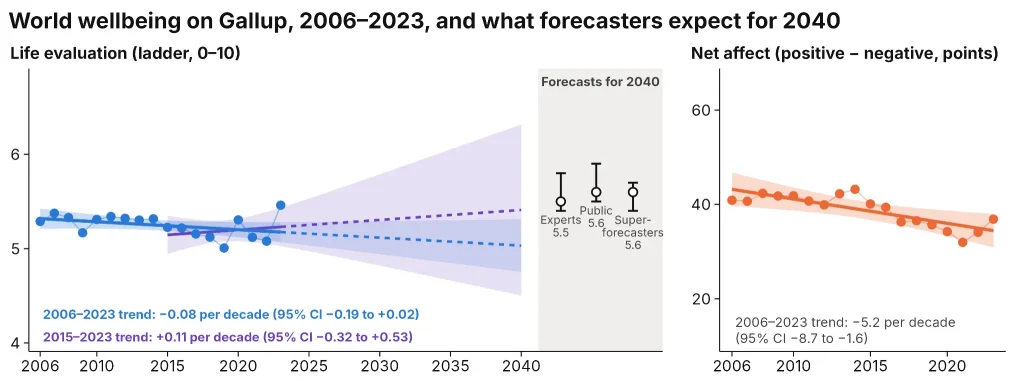
Note for the graph of world happiness trends8World averages of Gallup World Poll country means, population-weighted, with country and year fixed effects; surveys are dated by wave. Lines are linear trends fitted to 2006–2023 (blue and orange) and, for life evaluation, to 2015–2023 (purple). Solid sections cover the observed years and dashed sections extend each trend to 2040. Shaded cones are 95% intervals for the trend line, allowing for autocorrelation in the annual residuals. They show uncertainty about the trend, not the range a single year could fall in, and they are extrapolations, not forecasts. The life evaluation axis is widened to fit the cones; net affect spans 30% of its scale. On the right are the median forecasts of the world Cantril ladder on 30 December 2040, with unconditional forecasts from experts (n = 181), the public (n = 595) and superforecasters (n = 53), from LEAP Wave 10. Bars show the interval reported in the source. Their target is Our World in Data’s population-weighted World series, which is close to but not identical with the series shown, so compare levels loosely. Sources: Gallup World Poll; Murphy et al. (2025), The Longitudinal Expert AI Panel, Wave 10, Forecasting Research Institute..
This picture is obviously relevant to progress studies, the new discipline focused on understanding the dynamics of progress and how to accelerate it. I expect one response to graphs like these is to reject portraying wellbeing as a primarily psychological phenomenon. The thought, I expect, is “How could so much obviously good happen and happiness not capture it? If it can’t, then the measures are broken, misshapen, or they aren’t capturing most of what’s good and valuable.”
Jason Crawford, a leader in the progress studies community, conveyed as much when commenting on the apparently small link between material progress and happiness: “so much the worse for psychology, or more specifically, for making psychology the primary basis for our concept of human well-being.”9He goes on to say “A concept of well-being should be a guide—both in living our personal lives and in evaluating a society. It should indicate something substantive, and it should help us discover how to build well-being over time.”
This isn’t an unreasonable reaction. I tended to think this way before working in wellbeing, and I still think there may be real room for improvement in how we design and deploy these measures. But to me, these reactions would be too quick to dismiss the psychological component of wellbeing because it doesn’t mould itself to the common conception of progress. Having good mental states, whether that means a happy, satisfied, or meaningful life, strikes me (and many others) as a critical component of most conceptions of the good life. And to many (myself included), you need little else to live a good life10
Philosophers and laypeople appear to lean in opposite directions on whether wellbeing is mental (hedonism, life satisfaction) or about one’s conditions (objective list). In the 2020 PhilPapers Survey, about 53% of philosophers favoured objective list theories, against 13% for hedonism and 19% for desire satisfaction, or roughly 37% mental to 63% conditional once normalised. Laypeople reverse this. A rough reading of Bronsteen et al. (2024) gives about 71% mental to 29% conditional; participants treated all three theories as relevant but rated happiness as most important. Vignette studies agree. Kneer & Haybron (2024) find that mental states move wellbeing judgments more than life circumstances do, including how morally someone behaves, and Reuter et al. (2022) find hedonic states central to the folk concept of happiness. Within mental wellbeing, people prefer affect to life satisfaction (Adler et al., 2017). This split treats desire satisfaction as mental, on the view that life satisfaction amounts to a global desire theory. Counting desire satisfaction as conditional instead leaves laypeople roughly evenly split (48% mental to 52% conditional). Michael Prinzing summarised the lay view this way to me: happiness is positive hedonic states, wellbeing is mostly happiness plus some conditions (including morality), and a good life is mostly wellbeing plus further conditions.
. When you ask people what outcomes they would prefer, they typically choose mental wellbeing, and sometimes health, but rarely income (Adler et al., 201711“We show direct evidence that individuals trade-off levels of happiness with levels of income, physical health, family, career success and education in a large sample of UK and US individuals. On average, all types of happiness are preferred to other attributes except health.”; Benjamin et al., 2012, 2014).
To be clear, I feel the pull of the standard progress narrative. The progress we’ve made towards a wealthier and healthier world is real. Many more humans are living, and for much longer. I, for one, being born 3 months premature, probably wouldn’t have been alive if I had been born into a world without ventilators, antibiotics, or incubators. I like being alive. Sometimes, I am even tempted to love it. But an account of progress without wellbeing seems incomplete at best, and inert, sterile and uninspiring at worst.
Of course I’d say this, though; most of my work has been in wellbeing science, the field focused on understanding the causes of wellbeing and how to increase it. My time in the field has led me to think the wellbeing evidence suggests we’ve probably made less progress in psychological wellbeing than material conditions alone would suggest.
For instance, the global burden of disease estimates that anxiety and depressive disorders have been on an upward trend since they began providing estimates. And what are our first-line tools to treat them? With some mid-century edits to the curriculum, we’re still using the same technology to treat the most common mental health conditions: talking to someone in a structured way about their problems (i.e., psychotherapy). From a mental health and wellbeing perspective, progress looks a lot less apparent.
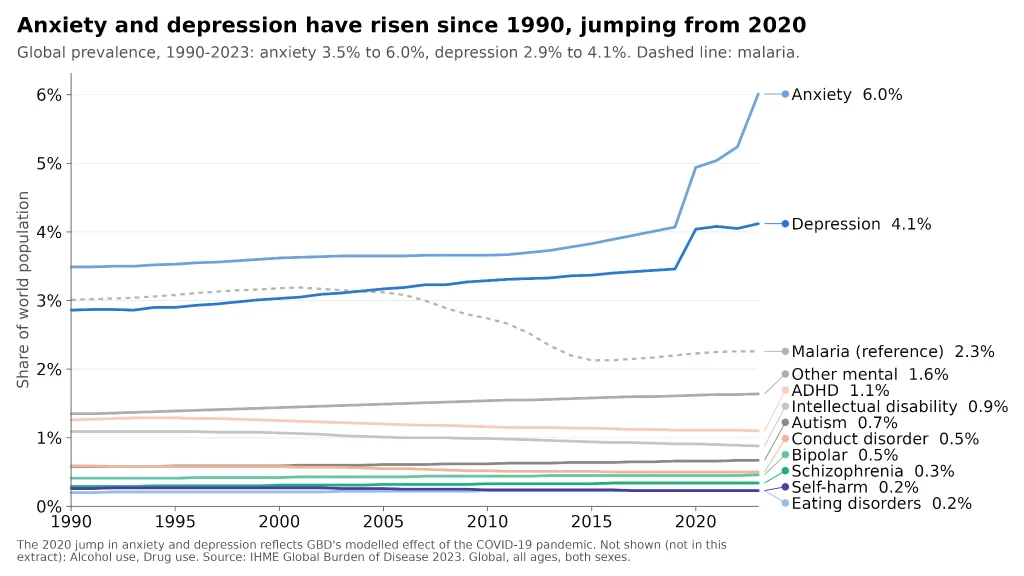
Note: Prevalence of mental health disorders (with malaria as a comparison point) according to the global burden of disease (Bloom’s Global Mental Health report).
Since I’m not starting from the premise that progress is real (although I’m sympathetic to the sentiment), but from the belief that people’s mental wellbeing matters, I view the surprising mixed relationship relating material progress to mental wellbeing as a fascinating mystery. But most mysteries are solvable, and I see part of this project’s purpose as revisiting the most important questions at the intersection of wealth and wellbeing and reconciling the differences between these two communities.
The merit of many ideas depends on how well they explain the world. And in at least one profoundly important way, I wonder if the wellbeing perspective could explain some of our problems better than a primarily material lens.
3. Politics: It’s the psychology, stupid?
Unhappiness has a natural anti-status quo bias. You’re much more willing to try something else out when you feel that what you’ve been doing hasn’t been working. How satisfied you are with housing, relationships or your job “has greater predictive power than does a combined set of economic and social variables” for predicting a change in those things (Kaiser and Oswald, 2022). This also applies to politics, where happiness data can outperform macroeconomic indicators in explaining vote share (Ward, 2019). Booting out the incumbent is probably rational if the unhappiness stems from past policies (e.g., the government’s response to COVID), but becomes more problematic if the unhappiness is unrelated to the political system (i.e., it’s due to COVID itself).
One of the clearest signs of widespread discontent in our politics is the rise of populism, a set of movements that emphasise the people in contrast to the elite, and are often characterised by appeals to negative emotion (Bliuc et al., 2026; Busby et al., 2019). Its recent prevalence has so far eclipsed its rather inglorious interwar peak (Funke et al., 2022).
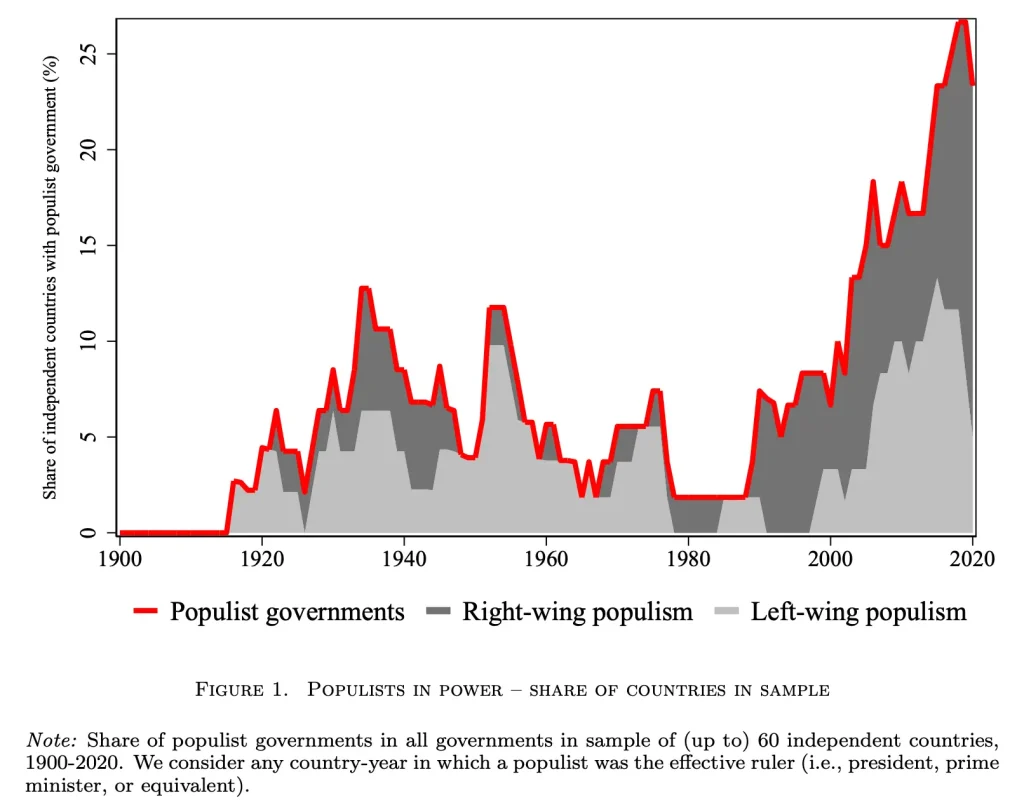
Populism’s rise is, perhaps unsurprisingly, predicted by discontent with one’s life (Nowakowski et al., 2021; Liberini et al., 2017; Algan et al., 2025 12E.g., Algan et al., 2025 estimates that supporters of extreme right or left parties in Europe are about -0.3 points less satisfied with their lives than the mainstream.
). Now, change is a reasonable corrective in the face of bad governance. But the more worrying feature of populist politics is that it often appears linked to democratic backsliding (Ruth-Lovell and Grahn et al., 2022; Berlucchi and Kellam, 2023; Vittori, 2021). Insofar as that’s true (it at least appears to be so in the US), my fear is something like “if you don’t like our liberal elites, just wait until you meet the post-liberal elites”.
One reason I think that the wellbeing lens is an important addition to discussions around progress is that I see some risk of liberal-minded discourse falling into a “let them eat progress” politics. During the waning days of the Biden administration, it was a common refrain amongst more liberal voices to point out how much inflation and wages had improved in recent years. The dissonance between traditional economic indicators and people’s attitudes toward the economy was so puzzling it sparked the coinage of the term ‘Vibecession’.
I see this tension as a throughline in many current debates that express befuddlement at the high watermark of disconnect between material conditions and psychological reality. I see this in JD Vance’s criticism of GDP, or in the debate between Scott Alexander and Cassie Pritchard about Liberal Happiness. Ezra Klein and Derek Thompson, the authors of “Abundance”, a pretty materialist book, seem in their writings and podcasts to be on a soul journey to find the missing ingredient in modern Liberalism. I think Noah Smith, the popular econ blogger, was onto something when he recently wrote a post titled “What if our biggest problems aren’t economic?”
“We should therefore think about whether our primary social problems are actually about material scarcity. The vast majority of Americans now possess not only the basic necessities of life, but a degree of economic security unimaginable to their forebears a century ago. It seems plausible to think that a great many Americans have climbed to the higher rungs of Maslow’s Hierarchy of Needs — that instead of where to get their next meal or how to save for retirement, they’re thinking about how to feel like they belong in their society, or how to get more status and respect.”
I think I agree, and I suspect that a better understanding of the link between wealth and wellbeing will bring us a bit closer to finding a politics that helps us preserve a good world and maybe, if we’re lucky and very careful, build a much, much better one.
The problem and why I probably couldn’t make things worse
I’ve tried to explain why I think the relationship between wealth and wellbeing matters. You might agree that it matters, but think there’s not much to do. On this point, I guess you will have to judge me by the fruit of my labours.
How I’m approaching this review
This living review will examine the evidence most relevant to making sense of progress from a wellbeing science perspective. My core aim is to provide an in-depth evaluation of the evidence linking mental wellbeing to the flagship measure of material progress: wealth, income, and economic growth.
I plan to stick to what I’m best at: turning groups of studies into spreadsheets and describing the resulting categorised and quantified evidence.
If there are meta-analyses or reviews on a topic, I plan to review the review and expand it if it’s necessary and useful. If there are no meta-analyses but a literature worth synthesising, I will try to quickly meta-analyse the top studies (e.g., top 10 to 20 papers). I don’t expect these to be up to academic standards, as I’ll probably be missing many papers and not have time to run all reasonably exhaustive analyses, so if an idea or finding seems promising or weird enough I’ll try to expand on it in a working paper or better yet pawn it off to a graduate student.
Before going into a topic, I’ll attempt to register some predictions about the arc ahead, so readers can understand whether I eat my hat or end up with conclusions suspiciously aligned with my priors. This should also serve as a form of “pre-registration” to keep myself accountable.
For the past five years, I’ve researched global wellbeing priorities at the Happier Lives Institute, where my work focuses on synthesising and applying evidence to find the best ways to increase global wellbeing. During this time, I’ve accumulated the list of questions I presented above that have begun to gnaw at me. I hope I can take some steps towards answering a few.