
-
Michael Plant
Note: This post first appeared on Michael Plant’s Substack on 11 November 2026, eight days before Anthropic’s stock market listing. We’ve kept it as originally written, so figures and forecasts reflect what was known at the time.
19th November 2026 may not be remembered by the history books but it will almost certainly be the biggest day for philanthropy the world has ever seen. Anthropic will become publicly listed in the US on that day, with a value of $1.1tn to $1.3tn. Anthropic staff have made serious commitments to give their money away – the 7 founders have publicly promised to donate 80% of their equity. The moment those paper valuations become real, this should represent the greatest unlocking of unallocated capital for philanthropic ends in the history of humanity.
This Anthropic story is a key part of what was originally called the “Third-Wave of American philanthropy” arising from AI-related wealth, which is expected to result in an additional $37bn to $100bn a year in new philanthropic funding. This has quickly, and unsurprisingly, ended up being called the “Funding Anthropalypse” instead. (Jack Lewars has an (excellent) eponymous Substack on the topic and credits Pablo Melchor with the name.)
What should a boy do, in the face of such a world-changing event? In my case, there was only one option. It is, of course, time to finally start that Substack I’d been thinking about for months, but never actually got around to. Here, I plan to share my lukewarm takes on happiness research, moral philosophy, and effective altruism, and maybe other things besides.
But, given this moment, the obvious place to start is with the question we should be asking: do we know how to spend $50bn a year to achieve maximum impact?
To relieve you of agonising suspense, I’ll get straight to it. The answer, it seems, unfortunately, is ‘not really’. What I’m going to do here is explain the state of play.
Two camps
I’ve spent the last 7 years of my life running a think-tank committed to finding the best ways globally to improve human happiness, the Happier Lives Institute. For the last year or so, I’ve been having, and seeing, increasingly frenetic conversations with others who advise philanthropists or evaluate charities on what recommendations to make to the soon-to-be-newly-minted wealth holders. My own focus on the Funding Anthropalypse sharpened acutely in the middle of this year, after HLI received some funding from Anthropic staff.
Curiously, opinions about how easy it is to allocate the resources fall into two camps – which I’m slightly exaggerating for effect.
In the first camp, spending the money is a big problem. The thought is “wow, this is so much more money than we’re used to thinking about, we’re really not sure what to suggest.” This is the typical view I’ve heard.
In the other camp, spending the money is no (big) problem. This view seems common among those who work — or worked — in international development. Their response to the first group is: “Wait, what? Didn’t you hear there’s just been absolutely massive cuts in spending for foreign aid? Like, really big. As big as the new AI-related money. So, it’s not that hard to spend big sums and, anyway, there is loads of great, scalable stuff to fund. Problem solved.”
The flag-bearers for this second camp are Rachel Glennerster and Leah R. Rosenzweig, hereafter shortened to ‘G-R’. Writing in the Center for Global Development (CGDev) blog in July, G-R said “We Can Spend $50 Billion a Year Effectively”.
Where are all the other proposals?
As far as I know, the Glennerster-Rosenzweigh (G-R) piece is the only public attempt so far to answer the question of how the full sum could be well spent; note, CGDev doesn’t take institutional position, hence this is the G-R view. There are lots of organisations that make recommendations about how much smaller sums of money can do the most good, including GiveWell, Rethink Priorities and the Happier Lives Institute, but which haven’t (yet) taken on the $50bn challenge.
The paucity of public proposals here is – or should be – puzzling. As I noted at the start, the Funding Anthropalypse will likely be the biggest event in the history of philanthropy, in terms of unallocated capital appearing. There are lots of philanthropic advisors out there, who you’d think would be lining up to make public suggestions.
There’s even a little movement, effective altruism, which was recently described by The Economist as “this century’s biggest idea”. Effective altruists (EAs) have long claimed that charities vary enormously in impact, with the best charities having 100x the impact of average ones; to put the same thought differently, it means some ways of allocating the resources would miss 99% of the impact they could have had. Assuming this claim is right, then working out how to spend this money well is among the most consequential tasks of the age. So, where are all the proposals? Where is the debate about how best to allocate the resources?
Plausibly, this is some combination of individuals and organisations being really uncertain about how to allocate that much money and thinking it would be presumptuous of them to make such a grand plan – this has certainly been part of my own hesitancy. Even so, it’s still a bit mysterious, given that effective altruists do like a grand plan, and what’s at stake.
Anyway, huge kudos to G-R for putting a concrete proposal on the table.
While I don’t have my own plan for how to spend all the $50bn, I’m not going to let that stop me from commenting on someone else’s. It seems useful to engage with the position that’s out there.
My assessment of the G-R plan is that it sets out how to spend $50bn in ways that are plausibly effective, but we’re still a long way off from what we’d ideally want to have, namely a considered plan for how to spend $50bn as effectively as possible.
I should declare an interest: I run an organisation built around one candidate for the common unit I’ll argue is missing, so readers may want to discount my views accordingly.
What is the G-R plan and where does it fall short?
The G-R post gives an optimistic pitch: decades of global health and development research, they argue, have already identified a set of programmes that are both proven and ready to absorb serious money immediately, without years of new piloting – though they stress the aim is not simply to fill gaps left by aid cuts.
In the proposal, 80% of the $50bn goes to unconditional cash transfers and “graduation” programmes (which combine a cash grant with training and mentoring to help households build a sustainable livelihood). The rest is spread across a handful of specific, named opportunities: scaling up Gavi-funded vaccination campaigns, funding the International Rescue Committee (IRC) to reach millions of currently-unreached “zero-dose” children, cash incentives to reduce vaccine dropout, treatment for severe childhood wasting (malnutrition so severe it kills over a million children a year), and Teaching at the Right Level (TaRL), a low-cost tutoring approach for primary schoolers.
Each of these gets its own short case for urgency and readiness. The wasting treatment section, for instance, notes that the IRC could treat far more children if funded — scaling from 600,000 to 10 million children a year within five years — and that doing so at scale would bring the cost down from $67 to $44 per child treated. TaRL, similarly, is presented as inexpensive (under $10 per child per year) and already endorsed by the Global Education Evidence Advisory Panel (GEEAP).
All of this is stitched together into a single table, “$50 billion: one way to spend it”, reproduced below. A footnote to the table says “impact is simply the allocation divided by the program’s unit cost […] impacts are not comparable across rows.”
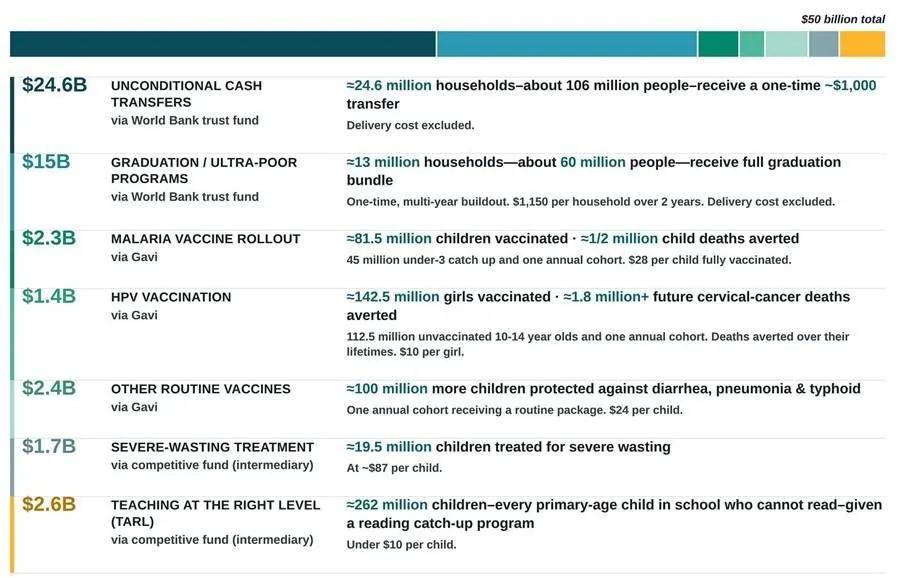

The implicit logic behind G-R’s recommendations, put into syllogistic form (forgive me, I am a philosopher) runs thus:
1. We know of several programmes that seem very cost-effective in their own terms
2. These programmes’ funding capacities add up to $50bn
Conclusion. Therefore, we know how to spend $50bn effectively.
However, what constitutes ‘effective’ spending is not defined and the argument is missing a premise, such as:
1*. Each programme clears some common bar of cost-effectiveness.
A problem is that without a shared unit the programmes are judged in, there’s no obvious way to compare their cost-effectiveness. And without any way to compare their cost-effectiveness, that means we lack a justification for why these programmes – rather than any others – are the ‘effective’ ones. Recall the CGDev footnote above that “impacts are not comparable across rows”.
To elaborate on the lack of a common currency, graduation programmes are pitched as dollars of consumption generated per dollar. Vaccines get described as “lives saved” in one sentence, but then converted into “between one and ten times more cost-effective than giving cash directly” later on. To do this, G-R appears to rely, via GiveWell’s cash benchmark, on ‘moral weights’ as an input, but moral weights are ultimately a judgement-based way of assigning values to apples and oranges. What we really want are non-arbitrary units that allow an apples-to-apples comparison. Severe wasting treatment and teaching and the right level are given straight per-child costs, with no benefit measure attached.
Some readers might think I’m being unfair to Glennester and Rosenzweig here, in criticising them for not doing something they have not attempted to do. Their table is clearly entitled “One way to spend it”, not “The best way to spend it”, and the note beneath it describes the figures as “very rough, illustrative calculations”. And their blogpost is called “We Can Spend $50 Billion a Year Effectively”, not “We know how to spend $50bn as effectively as possible”.
But this is exactly my point. Their suggestion is one way to spend it, and it’s plausibly an effective way to spend it, but presumably what we really want is a worked-out suggestion of how best to spend it. That requires more of a comparison of the options than we have here.
G-R’s post does suggest where that comparison might come from. They propose that donors work with intermediaries such as J-PAL and the DIV Fund to run competitive calls for large scale-ups, with implementers bidding and the intermediaries judging the bids. That seems sensible. But it kicks the comparison can down the road, as these intermediaries then face the same challenge: how do they compare and rank the options?
Okay so what, ideally, are we after?
In theory, we’d want a ranked set of options, evaluated for their expected cost-effectiveness in meaningful, comparable units, where the total funding gap of the list exceeded $50bn — or whatever we thought the maximum budget was.
Assuming the objective is to do the most good, the question of “how do we spend the money?” becomes straightforward: you start by funding the items at the top of the prioritised list and work down until you run out of money.
Thinking this way also clarifies what ‘the bar’ is for funding. The bar is simply the place where your money runs out, after working down the prioritised list. Lots of people seem to think a ‘bar’ for cost-effectiveness should be done in fixed, absolute terms, e.g. “our bar is 5x cash transfers”. But if you’re trying to do the most good, that’s not really the right way to think about it. You want to set the bar in relative terms, because if you’re maximising, the bar is necessarily relative to your comparison of the available options and when your money runs out. If you set your bar lower than the best options you can fund, that means you’re knowingly sacrificing impact.
This might all sound a bit abstract, but let’s now apply it to the G-R proposal.
The thing that sticks out is that cash transfers are almost half the total, at $24.8bn, and graduation programmes – a sort of ‘cash transfer plus’ – are another $15bn. Between them, they cover almost 80% of the $50bn. Because cash transfers are extremely scalable, and can absorb almost unlimited amounts of money, they effectively set the ‘bar’ and ‘overflow’ of the proposal: unless you think you have something better to recommend than cash, you recommend cash.
Let’s assume that G-R somehow ranked options by cost-effectiveness (in a way not set out in their post). This would imply that G-R thinks they ‘only’ have about $10bn of interventions better than cash, because anything worse than cash would simply not have made it onto a prioritised list.
What this means, for those of us interested in spending $50bn as well as possible, is that the real challenge is to find things that are better than cash. The stakes here are actually enormous. Suppose we identified something 5 times as cost-effective as cash transfers that could absorb $5bn a year. Moving $5bn a year from cash to that intervention, whatever is it, would have an impact equivalent to spending an extra $20bn a year on cash transfers and, lest we forget, that’s quite a lot of money.
And now we get (back) to the nub. To be able to do this, we need a way to compare cash transfers to the alternatives. That requires us to have a sensible common unit, and then empirically do the comparisons. We could compare cash transfers to other poverty alleviation programmes by looking at increases in consumption, which is roughly how G-R presents graduation programmes.
While consumption matters, it is presumably not the only thing that matters. And the challenge is to compare it to other things where the impact is clearly not well captured by consumption. Looking at the list, I assume most people won’t want to compare vaccines, malnutrition and teaching children to read solely by their impact on consumption. What we need is a unit that captures what these things each do to people’s lives overall, not just one dimension of them.
Until and unless we have that, we don’t really have a good way to compare the cost-effectiveness of cash to all the relevant alternatives. And without these comparisons, we don’t have a sensible, empirically-grounded way to determine how that $50bn could do the most good.
A conclusion
The arrival of tens of billions of dollars in new philanthropic funding is an extraordinary opportunity. But having enough good things to spend it on isn’t the same as knowing where the money will do the most good. And if the difference between good and best is potentially worth tens of billions of dollars in additional impact, it’s a question worth taking seriously.
In a subsequent post, I will offer an answer to the question “how can we work out how to spend $50bn as effectively as possible?”
For those familiar with the Happier Lives Institute’s work, you won’t be surprised to hear it’s something to do with wellbeing. For those unfamiliar with its work, stay tuned for the (questionably) big reveal – given I’ve already said it’s to do with wellbeing.
-
Michael Plant