
With research by us at the Happier Lives Institute, Bloom Wellbeing Fund has recently released a new report providing an up to date overview of the problem of mental illness, and the best ways to solve it.
Here are our top takeaways from the report, which are an edited version of the summary shown in the report.
Poor mental health, a big problem
Mental health problems are exceptionally painful: Mental health problems (such as depression, anxiety, and schizophrenia) can cause intense suffering and interfere with daily functioning. They are among the most misery-inducing of life’s common misfortunes. Depression and anxiety reduce life satisfaction by around 1 point on a 0–10 scale – that’s roughly twice the impact of unemployment, divorce, or chronic physical conditions like arthritis.
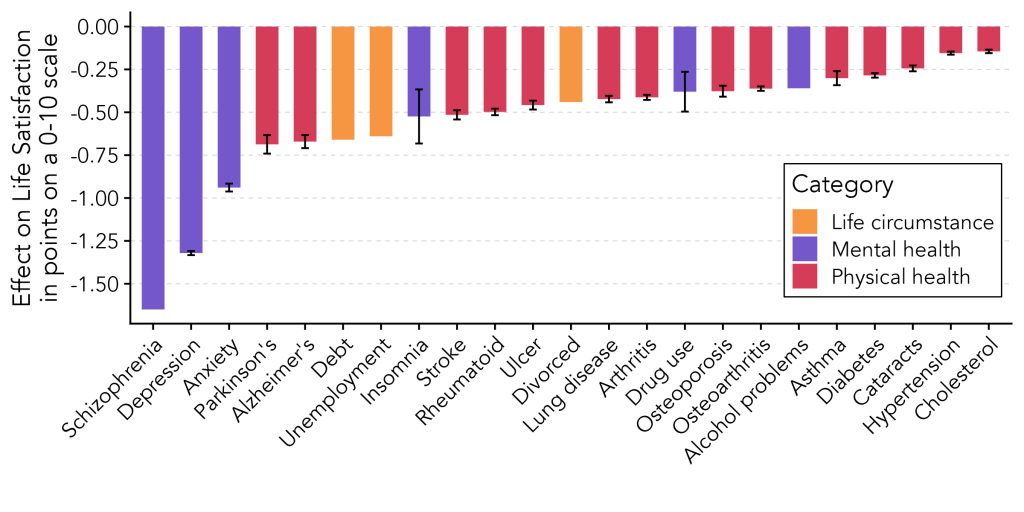
Mental health problems are very common: These conditions are not rare. The most recent and reliable data indicate that 18% of the global population currently lives with a mental health condition – up from 16% in 2019 and 17% in 2021 – around 1.5 billion people. The number is much higher if we’re talking about lifetime prevalence. For example, the number of people currently experiencing depression globally is around 5%, but the amount who will ever experience it is ~5 times larger at around 25%.
So what do you get when you combine a problem that is painful and prevalent? You get a problem that represents 8.63% of the health burden worldwide (measured in disability adjusted life years, DALYs). This might not sound like much, but it puts it as a problem on par with malaria, tuberculosis, and HIV/ AIDS combined.
Neglected: Despite having a comparable burden on health to HIV/AIDs, Malaria, and tuberculosis combined, it receives 0.47% of the health-directed aid (compared to 55.38% for the other three diseases combined).
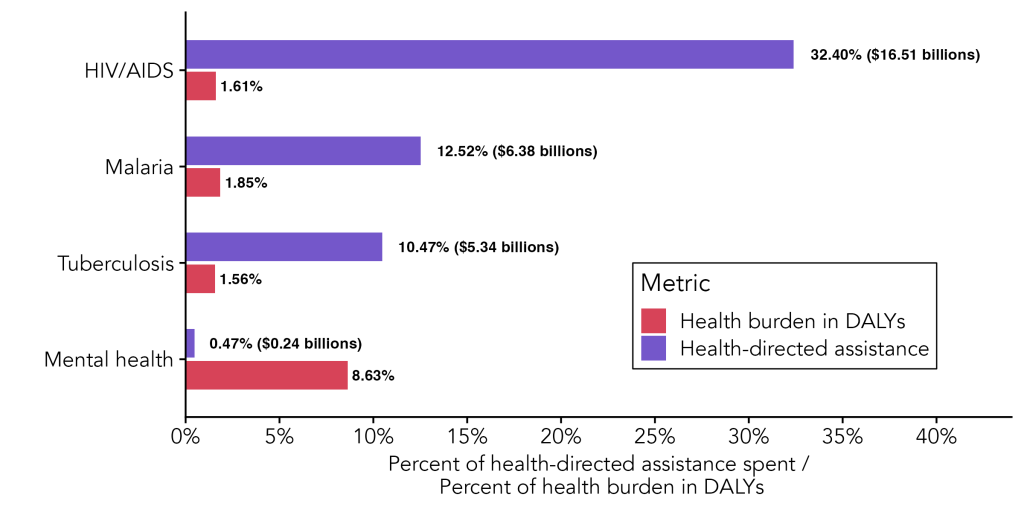
Yet this low level of funding isn’t because there are no solutions. In fact, most common mental health disorders like depression and anxiety have been proven to be effectively treatable for less than $50 a person, and these treatments are cost-effective.
The top solutions to most mental health problems
In low and middle income countries, where most of the untreated burden of mental illness, there are effective solutions waiting to be scaled for anxiety, depression, and suicide prevention. There are promising treatments that require further research and validation for reducing anti-social behavior, and the burden of substance use disorders. Schizophrenia and some types of bipolar still require identifying promising solutions in low income countries.
1. Ready to scale
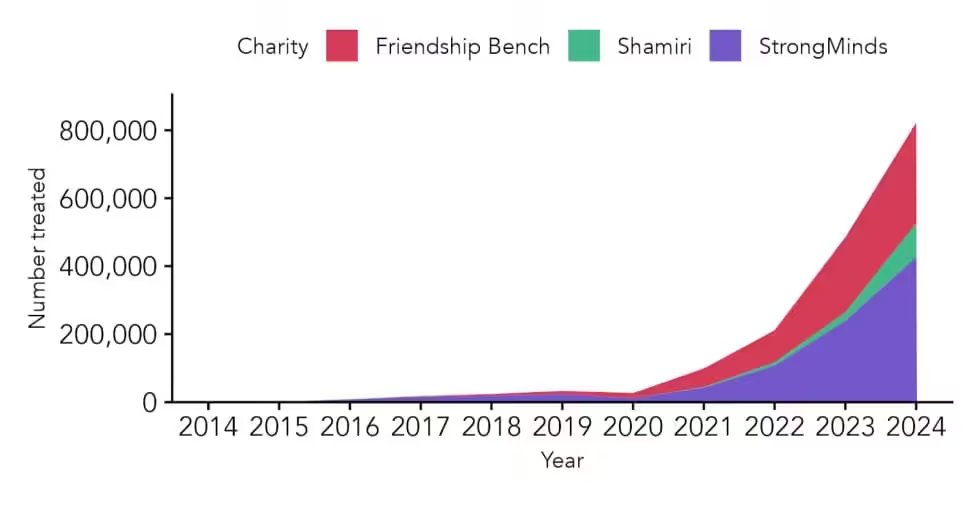
Depression and anxiety. For common mental health disorders like depression and anxiety, psychotherapy can be very effective. Therapy reduces depression symptoms by half or more in 42% of cases.1This is from a meta-analysis including 441 trials of psychotherapy (Cuipers et al., 2024). And these benefits can last. In one trial of CBT in Pakistan, researchers found that depression rates were 17% lower seven years later. Moreover, it can be delivered affordably and at scale. Resource constraints have led to innovation and the “task shifting” model, where specialists train lay deliverers, who then provide the therapy. This vastly reduces costs, while research shows that it only leads to a modest (~25%) reduction in effectiveness. This “task-shifting” model has been successfully implemented by charities such as StrongMinds, Friendship Bench and Shamiri, which provide effective and evidence-based care in Sub-Saharan Africa. Amongst available options, this is the most robust and best-researched bet for improving global mental health. The scale-up of treatment by the most prominent organisations we mentioned above has been massive, with treatment expanding around 10-fold from 2020 to 2024.
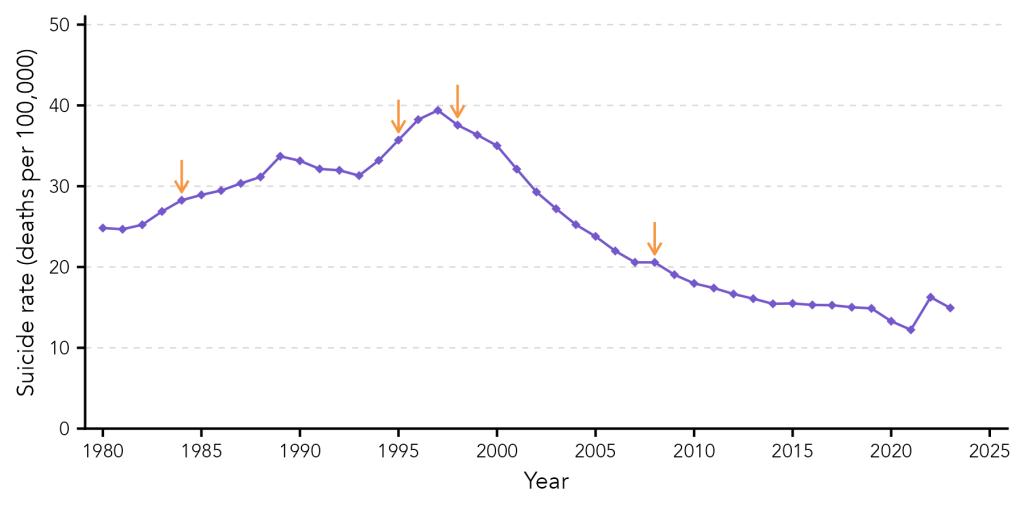
Self-harm and suicide. Restricting access to highly toxic pesticides can reduce suicides by 7% to 45.1%, particularly in rural areas of low income countries where they are a common means. While this approach does not address underlying psychological distress, it can significantly reduce deaths. The Centre for Pesticide Suicide Prevention (CPSP), a philanthropically funded initiative, collaborates with governments to implement such policies and has been positively evaluated by the charity evaluator GiveWell.
The case of Sri Lanka is illustrative. Suicides gradually increased after the widespread use of pesticides started in the 1960s. After a series of pesticide bans (indicated by arrows), they stabilised and decreased dramatically.
2. Promising but needs more research
Crime and antisocial behaviour. Cognitive behavioural therapy (CBT) can be used to prevent crime and improve wellbeing among at-risk youth and former offenders. In one RCT they found that even 10 years after it was delivered, the programme found large reductions in criminality (34 fewer reported thefts a year, about a 50% reduction), with the authors claiming their results imply a cost of roughly $1.50 per crime avoided. In Colombia, the charity ACTRA is piloting such an approach, developing interventions grounded in CBT principles to promote wellbeing, social cohesion, and reduce recidivism. Although there is some evidence supporting this intervention, it has not yet been scaled up for implementation by a charity.
Alcohol and substance abuse. Brief interventions (like a single counselling session reducing alcohol consumption by 8% a year later) and policy reforms (for example, doubling alcohol taxes may reduce alcohol consumption by 10%) show potential in addressing harmful substance use, though the evidence base is thinner here than for other problems. Philanthropic initiatives, such as Sangath and policy-focused efforts, like Reset Alcohol and Concentric Policies, represent early opportunities for learning about the impact of such projects. Further research is needed to identify the most cost-effective approaches.
3. Needs exploring
For conditions such as schizophrenia and bipolar disorder, combining medication with psychological and social support is effective in high-income contexts. However, these treatments are costly and difficult to deliver at scale in LMICs. More research and innovation are needed to see if there are clear opportunities for philanthropic funding in these areas. These are the disorders for which there is the greatest uncertainty about what works, but, given the enormous social costs of these conditions, they merit further investigation.
A call to contribute to improving mental health worldwide
Most of us know people who have suffered severely from mental health conditions. Many of us ask ourselves what we would give to help restore those people to living a full, flourishing life. Fortunately, we have the means to turn that desire into reality. If we fund the right interventions, philanthropists and governments could effectively and affordably save millions of lives from suffering related to mental health problems. Despite the scale of the problem, mental health continues to receive far less funding for treatment and research than problems responsible for a comparable disease burden. International mental health funding has inched up from $185 million in 2019 to $239 million in 2023 – and is forecast to fall back to $168 million in 2024, even as the prevalence of mental illness continues to rise. Set against a condition responsible for 8.63% of the world’s health burden, $239 million is a rounding error.
With funding scarce and now forecast to fall, philanthropists can have an outsized impact by keeping critical projects alive, shaping field priorities, and steering mental health toward a more effective, evidence-driven future.
How you can help:
- Partner with Bloom and the Mental Health Funding Circle to build and strengthen the nascent field of effective giving for mental wellbeing.
- Support high-impact charities delivering proven interventions.
- Advance the evidence base by funding evaluations of promising charities and the research needed to discover the next generation of effective solutions.
- Join the conversation by sharing your ideas, feedback, or questions—we are keen to collaborate. Get in touch if you want to help, but you aren’t quite sure how.
Read the report for more details, it’s really one we’re proud of.