

The WELLBY
- Home
- The WELLBY
What is a WELLBY? Understanding Wellbeing-Adjusted Life Years
A WELLBY (Wellbeing-Adjusted Life Year) is a way to measure how much an intervention or programme improves someone’s overall wellbeing. One WELLBY equals a one-point increase in wellbeing on a 0-10 scale for one person for one year; often, the measure used is life satisfaction.
When we think about transforming people’s lives, we often focus on physical health and wealth. But what about other important factors like freedom, relationships, or mental health? How do we measure these benefits in a meaningful way? This is where WELLBYs come in.
What is a WELLBY?
A WELLBY (Wellbeing-Adjusted Life Year) is a way to measure how much an intervention or programme improves someone’s overall wellbeing.
Standardised measures of health, such as QALYs (Quality-Adjusted Life Years) have been used for decades to prioritise healthcare resources1QALYs have been researched for over 50 years and implemented in decision making since then (Spencer et al., 2022). Most prominently the UK’s National Institute for Health and Care Excellence (NICE) uses QALYs to identify whether medical interventions are cost-effective (“NICE says it generally considers that interventions costing the NHS less than £20,000 per QALY gained are cost effective and those costing up to £30,000 per QALY gained might, with certain conditions”; Ogden, 2017). This has a large influence on how the UK’s National Health Service spends (Rid et al., 2015)..
WELLBYs are a newer approach2Brazier & Tsuchiya, 2015; Frijters et al., 2020; Layard & Oparina, 2021 which makes it possible to compare across the benefits or harms of a much wider set of interventions.
How to calculate a WELLBY
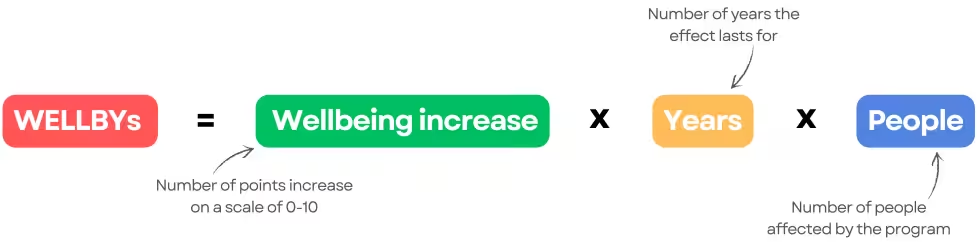
One WELLBY equals a one-point increase in wellbeing on a 0-10 scale for one person for one year (or equivalent); often, the measure used is life satisfaction.
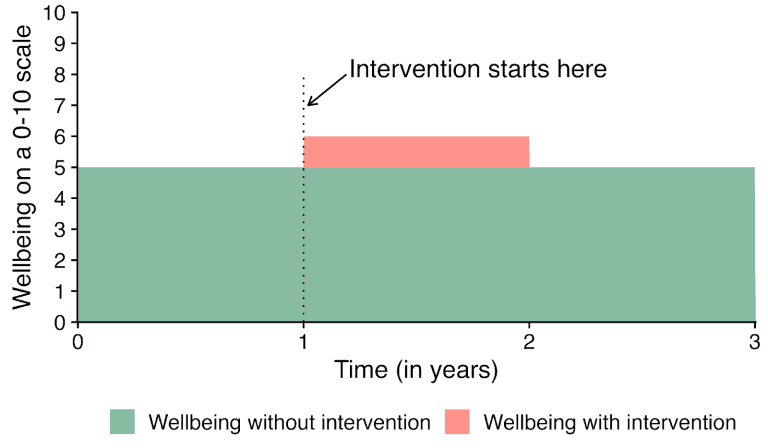
Think of it this way: if someone rates their life satisfaction as 5 out of 10, and an intervention helps them improve to a 6 out of 10 for one year, that’s worth 1 WELLBYs.
Why Do WELLBYs Matter?
Often, we want to make people better off – for instance, if we’re giving to charity or thinking about government policy. And, we want to know if we’re having an impact – or not. This means we need a way to measure impact.
At the moment, decision makers often look at objective indicators, like health or wealth, crime rates. But these don’t capture how people feel or experience life. And there’s no easy way to compare the impact between them. Say one option treats mental health and another reduces poverty. Which makes a bigger difference?
This is where WELLBYs come in. They solve this problem by:
- Capturing the full picture of how interventions affect people’s lives.
- Letting people tell us directly how their lives are going.
- Making it possible to compare different types of programmes or interventions.
- Revealing benefits that other traditional measures (like health, income and education) might miss like unemployment,social cohesion, or extra leisure time.
How Do We Measure WELLBYs?
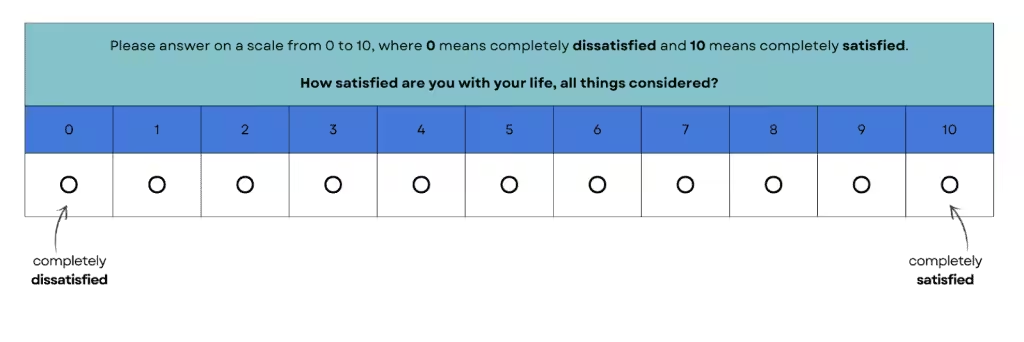
This might sound too simple to be meaningful, but decades of research show these measures are reliable, valid and comparable between people. Countries with more poverty, conflict, and instability consistently show lower life satisfaction scores, while those with better living conditions show higher scores (see the map below using the 2024 data from the Gallup World Poll – and lagging countries with missing data).
Comparing charities with WELLBYs
Let’s look at some concrete examples. The Happier Lives Institute has compared a variety of approaches to help people living in low-income countries.
Using WELLBYs, we found that some interventions are MUCH more cost-effective than others. Some charities are 100s if not 1000s of times more cost-effective than others. This includes some surprising, potentially counterintuitive findings such as psychotherapy produced about five times more wellbeing per dollar spent than cash transfers. This figure is up to date as of the 26th of March 2026. For more up to date comparison of WELLBY cost-effectiveness, see our Living Review.
Why WELLBYs Matter for the Future
As we tackle complex global challenges, we need better ways to measure what matters – transforming people’s lives. WELLBYs offer a practical tool to:
- Compare different types of programmes and interventions
- Make better decisions about where to invest resources
- Capture benefits that traditional measures miss
- Put people’s actual experiences at the center of decision-making
How are WELLBYs Used?
Both the UK and New Zealand Treasuries have guidelines on using WELLBYs, in principle, to assess whether different policies are good value for money. Academics, like the LSE value for money group, have also used it, in practice, to evaluate specific policies.
This focus on comparing policies in terms of their wellbeing impact can be seen as a natural next step. In the past two decades, 37 countries have started measuring the wellbeing of their citizens.
There are also organisations like the Happier Lives Institute (that’s us!), Pro Bono Economics, and State of Life, that use the WELLBY to evaluate charities and interventions. We already added HLI’s cost-effectiveness comparisons for charities above. Note that the charities we evaluated are all in the Global South, so our analyses also have implications for how to get greater value for money from international aid.
All the efforts to use WELLBYs to analyse charities are recent, and began only within the last 5 years3The first ones we know of were in Plant (2019), and the first explicitly couched in WELLBYs were all published in 2021: by Frijters and Krekel (2021), State of Life (2021), and the Happier Lives Institute (2021)..
Comparing policies with WELLBYs
We can also provide a similar figure to the previous one but for the cost-effectiveness of policies in high-income countries based on data from Frayman et al. (2024), Frijters and Krekel (2021), and various reports from State of Life.
WELLBYs, summarised
WELLBYs represent a significant step forward in measuring what matters most: how much better off people actually feel. By directly asking people about their wellbeing we can better understand what truly improves lives and make more informed decisions about how to help others effectively.
Whether you are a policymaker, philanthropist, or simply someone interested in making the world better, understanding WELLBYs helps us focus on what really counts – making people’s lives genuinely better in ways they themselves can feel and report.