

The 2025 World Happiness Report and our chapter on how best to buy happiness for others (i.e., give effectively) were recently released. So we thought it was a good time to answer several common questions we hear about happiness, giving to charity, and maximising the happiness per dollar donated.

1. Which charities should I donate to?
Answer: Donate where it’ll increase happiness the most.
We don’t think charity’s purpose is to make ourselves happier (see Question 2). Rather, the primary purpose is to make a difference for others.
It’s not a huge leap from there to thinking we should try and make the biggest difference we can, or, at least, a bigger difference. It mostly takes believing that saving two is better than one if there is no difference in the sacrifice required.
In other words, we think you should be an ‘effective giver’. This may seem common sense. In one survey, 87% of respondents said they’d reallocate donations to a highly effective charity away from what they previously gave to.
Given that we’re the Happier Lives Institute, you may be shocked to hear that we think happiness is what we should be trying to increase for others.
We seek happiness for ourselves. Parents say it’s all they want for their children. The US Constitution goes so far as to say the pursuit of happiness is an inalienable right. In most cases, people value it more than anything else. So, given all that, we think charitable giving should focus on increasing happiness.
For a more in-depth justification for this, read Our Philosophy page and look here for the charities we’ve found that increase happiness the most.
2. Will donating to charity make me happy?
Answer: Yes, but that shouldn’t be the only reason you do it.
It’s a well-established and replicated finding that giving to others makes you happier. Not only that, as Chapter 2 in the World Happiness Report notes, the relationship between giving and happiness is much larger than other prosocial acts like volunteering or helping a stranger.
Indeed, the relationship between giving in the last month is more than twice as large as the estimated effect of having one’s income double.
This is great. It’s a fortunate fact that altruism is often its own reward. But we think it’s important to focus on the obvious but still underappreciated point:
Giving is about helping others.
Reminding ourselves about the goal of giving or donating is important for several reasons.
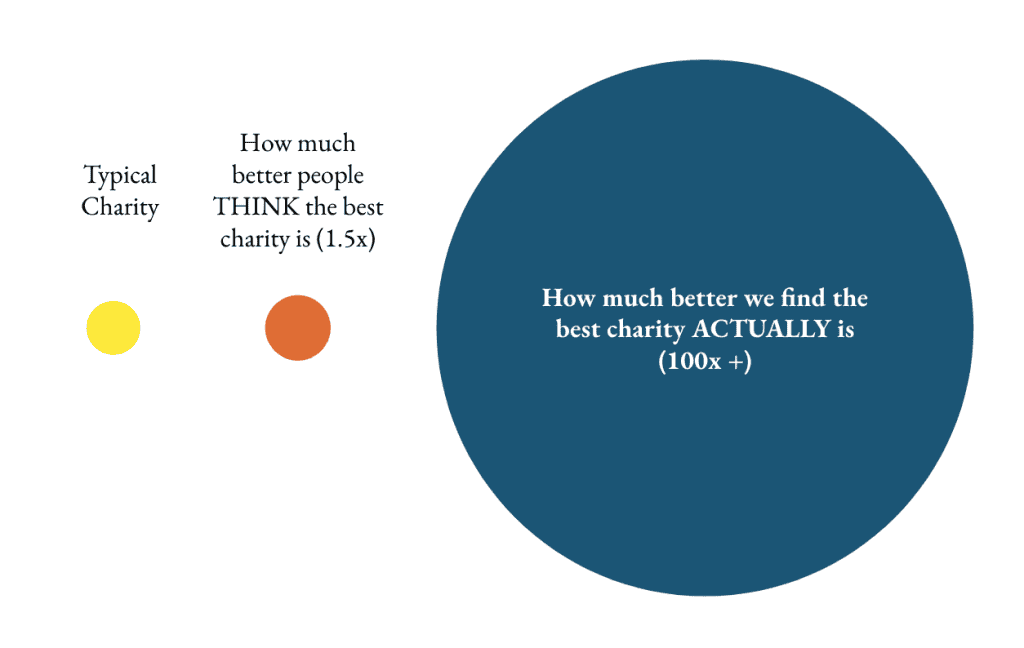
First, if our giving is guided by our preferences and interests, we’ll probably miss out on the profound benefit we can bring to others. As our chapter illustrates, it comes as a surprise to most, but if you give carefully and fund the best charities, you can do potentially 1000x more good!
Second, if your only motivation is your own benefit, then you’re probably going to be disappointed in the outcome.
A review of the relationship between helping and happiness finds that doing good increases happiness the most when it’s done for reasons unmotivated by personal gain.
3. Does giving effectively increase the giver’s happiness more?
Answer: We’re not sure, but we don’t think you’ll be less happy if you give effectively!
Someone may be concerned that giving effectively might mean losing some of that positive feeling you get from supporting your favourite project. That’s fair, but ultimately, I don’t think we should worry about losing happiness by giving more effectively.
We know from chapter 2 of this year’s World Happiness Report that helping others increases happiness the most when the helper has:
- A clear positive impact (pro-effective giving)
- A choice in how to help (doesn’t favour any type of giving)
- A caring connection to the recipient (favours warm-glow giving)
But as we’ve argued, having a caring connection with the recipient is potentially at odds with having a clear positive impact, since we can typically help people living far away from us hundreds or even thousands of times more than our neighbours and friends.
But thankfully, it’s a false tradeoff to choose between supporting your favourite project and highly effective charities.
There’s a simple solution: you can split your donations. Perhaps you give 80% of your yearly donation to effective causes, and put aside 20% for things close to your heart. But certainly, we think some of our giving should be going to the charities that create the most happiness with our money.
I expect that splitting your donations may actually boost your happiness since research finds that donors who gave both to their favourite charity and a highly impactful one are viewed as the most competent and warm.
4. Is there something cold-hearted about giving based on calculations?
Answer: No, we think it’s the opposite, and research finds that when people reflect on this, they tend to agree.
To elaborate on this, we quote from Schubert and Caviola book on the psychology of effective giving, which explains this well.
“To some, this single-minded focus on numbers seems cold— as if prioritising the greatest impact means neglecting individuals in favour of abstract statistics. But nothing could be further from the truth. We strive to save the greatest number of people precisely because individuals matter. Each number represents a real person with a life, a family, and a future.
As Derek Parfit put it, ‘Why do we save the larger number? Because we do give equal weight to saving each. Each counts for one. That is why more count for more.’”
5. How much money should I donate to charity?
Wouldn’t I make the biggest difference to world happiness by giving everything? So doesn’t this imply I should give everything?
Answer: As a rule of thumb, the right amount to give is the largest amount that you can sustain.
If you want something more specific, Peter Singer (the originator of the shallow pond thought experiment) proposes a stepped scale. It starts at 1% for those earning $40k-$80k, is 5% between $80k-$120k, and eventually rises to 50% for those earning over $50m.
6. I already give to [insert charity]. Is it wrong for me to switch to something more cost-effective?
Answer: In short, no.
Some people are understandably reluctant to switch because it feels like they are letting down the organisation they’ve been supporting and the people it benefits.
But if you think an alternative charity will do more good per dollar, it helps to keep in mind the point of giving. The point is typically not to help the people working at charities (who you may disappoint by switching), but it’s about helping people in need. And if you believe you’ll help more by switching, that seems not only free of blame, but praiseworthy.
7. Why should I donate to charity?
Answer: Because people are suffering somewhere.
The classic argument for doing good, even when it costs you something, comes from the philosopher Peter Singer. He asks us to imagine we are walking past a shallow pond, when we suddenly see that a child is drowning. We can jump in and save that child, but this will ruin our brand-new suit. Are we morally required to save the child at some cost to ourselves?
The reaction most people have is that we must wade in. The principle that appears to explain this reaction is that, as Singer puts it:
“If it is in our power to prevent something bad from happening without thereby sacrificing anything of comparable importance, we ought, morally, to do it”.
8. What if other people don’t donate to charity?
Answer: Give anyways, because the good won’t otherwise get done.
In comparison to the scope of the world’s problems, any individual contribution seems paltry and insignificant.
Indeed, it would feel profoundly discouraging to sit on the bank of a pond and see lots of people standing there as a child drowns. But even if that was true, don’t you think you should jump in anyway – and perhaps encourage others to do so too – rather than sit it out?

Thankfully, there are a lot of people trying to better the world in small or grand ways. Each year, over a billion people donate more than $500 billion to charity because they want to help others.
9. But do I need to give if others are donating already?
Answer (the same as last time): Give anyways, because the good won’t otherwise get done.
We’re less likely to help if we think that other people will do it. In one study of the psychology of altruism, they found:
“When there are other people around who also could provide help, we feel less obligated to provide help and less obligated to choose the most effective ways of helping.”
But worrying that others may do the good we might is sadly misplaced.
This isn’t because people aren’t altruistic. They are! People regularly risk their lives and sacrifice their own comfort and safety for the sake of people they will never know.
There are many important and pressing problems to solve:
- Extreme poverty is not on the cusp of being alleviated.
- Cheaply preventable diseases like malaria are not about to be eradicated.
- Common sources of suffering, like depression, remain almost entirely untreated in many countries.
If you try to do good, it’s rarely wasted.
I want to donate, where do I start?
You can start by donating to our recommended charities. These charities are some of the most cost-effective at improving happiness.
You can also donate to us to fund our research in finding ways to improve happiness globally.