
-
Michael Plant
Note: This post first appeared on Michael Plant’s Substack on 19 November 2026, the day of Anthropic’s stock market listing. It’s the second in a series following this post. We’ve kept it as originally written, so figures reflect what was known at the time.
Today is a huge news day for effective altruism. Anthropic lists later today with a reported valuation of $1.5tn with great expectations of this translating into $37bn-$100bn per year of new philanthropic funding. It also happens to be the launch of the Netflix drama, The Altruists, about the rise and fall of infamous crypto-fraudster and sometime EA poster-boy, Sam Bankman-Fried.
So it seems a good day to pick up the question we should be asking: what are the best ways to spend this new money to achieve maximum impact? I want to make two points.
1. We don’t have what we’d ideally want: empirically grounded recommendations on how to prioritise. The underlying difficulty is that the options are very different, and there’s no agreed way to compare them.
2. There is at least one area where we can compare empirically: interventions that improve human lives, by using the WELLBY metric. But that work hasn’t been done at anything like the scale the money needs.
What we have, and what we want
In my previous substack, I examined the only public proposal at the time, a post on the Centre for Global Development (CGDev) by Rachel Glennerster and Leah Rosenzweigh, entitled “We can spend $50bn a year effectively”. This presented a set of promising ‘buys’ in global development which summed to $50bn.
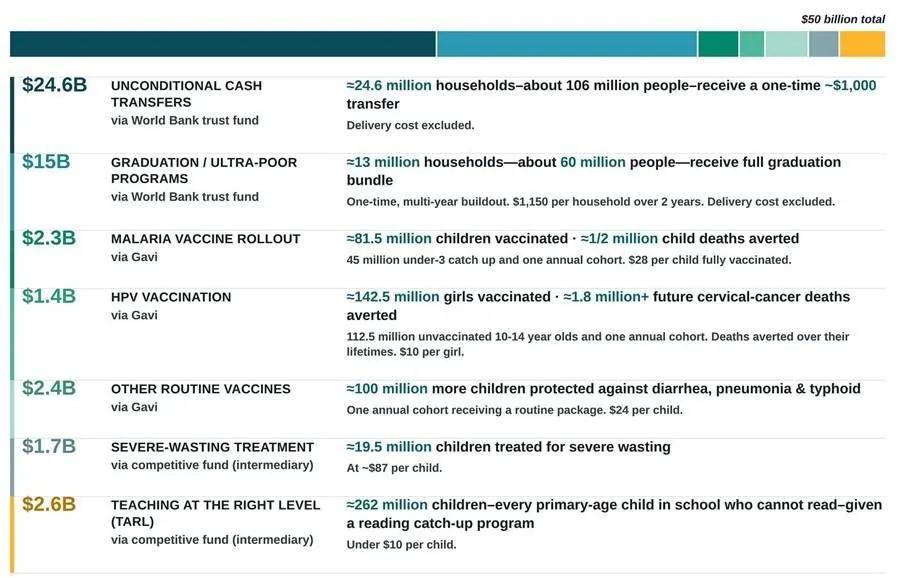
I pointed out the crucial limitation of this is that it was not a prioritised list: it didn’t compare different options by cost-effectiveness. Without that comparison, we don’t yet know how to spend that money to do the most good. It’s a list of plausibly good options, but we’re still short of analysis on what the best options are, or a way of determining what should be on the list, and what shouldn’t.
I also noted how strange it was that there weren’t more public proposals for how to spend this philanthropic funding to have maximum impact, particularly given the longstanding effective altruist claim that some charities are hundreds of times better than others.
In the last week there’s been a second proposal: Coefficient Giving, which is expected to advise many of the new Anthropic donors, published 25 ways the money could be spent well, adding up to nearly $610bn a year.
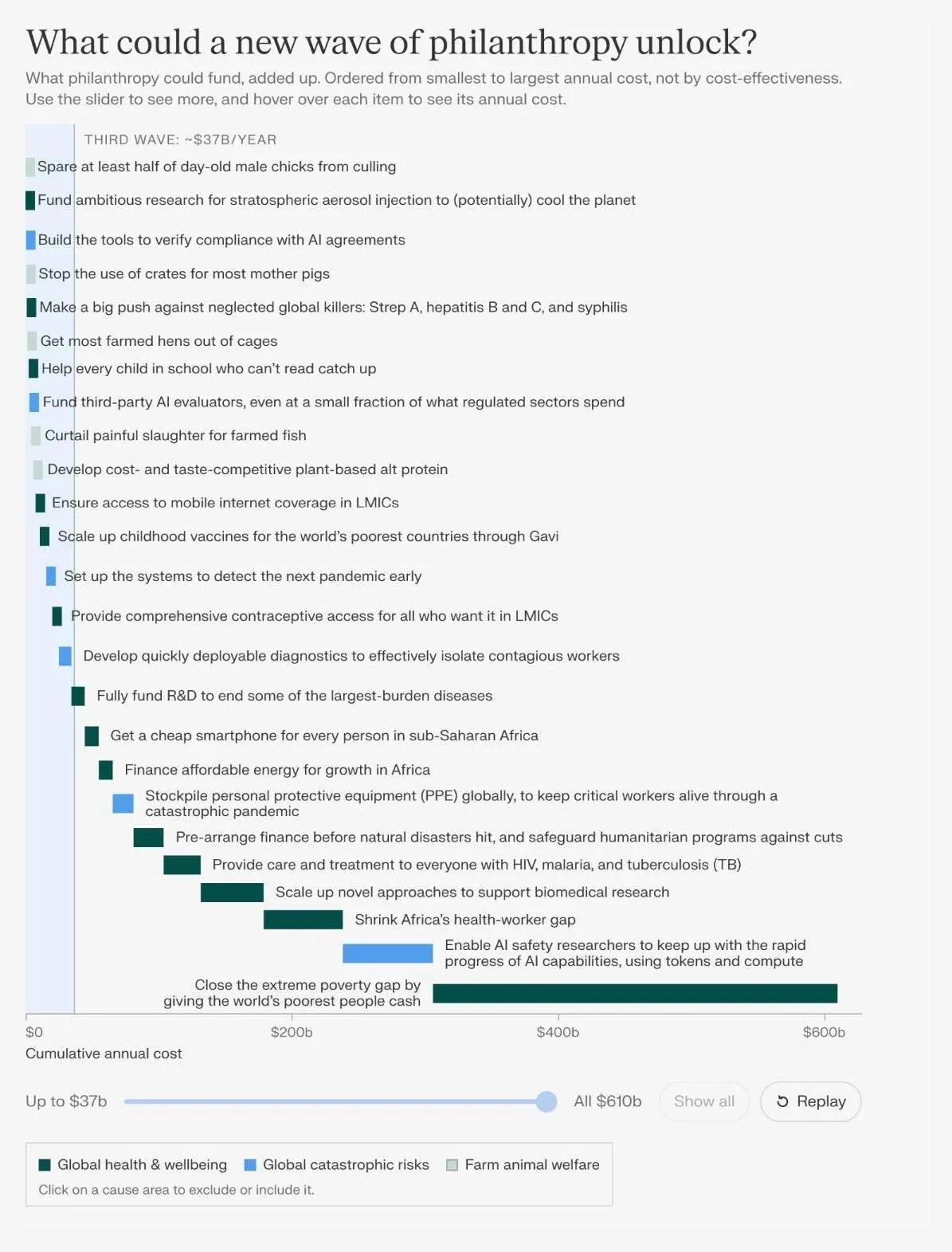
This proposal has the same crucial limitation as the first: it doesn’t prioritise between the options. Coefficient acknowledges this explicitly, noting in footnote 3 that the table doesn’t differentiate by cost-effectiveness. It’s intended to illustrate the range of promising opportunities, rather than identify which offer the greatest impact per dollar.
That’s useful, but it leaves the central question unanswered.
To see the problem here, suppose you’re a (new mega)donor committed to doing the most good and you’re wondering what to fund. You don’t have $50bn to spend, let alone $600bn, so you can’t fund everything and need to prioritise. You look at the options on the CGDev blogpost and the Coefficient Giving one. How do you know what to pick? There’s also no way to compare the options within or between the lists. Obviously, you don’t want to pick at random.
A natural thought is that you’d ask the staff at each organisation what they’d recommend. If you did this, you’d then want to ask “Why? “How are you comparing the options?” You’d find the comparison rests on a mix of intuitive guesses about the facts and individual moral judgements. There’s no particular reason to defer to someone else’s. I may well have misread either proposal; if their authors think so, I’d like to hear it.
Why it’s hard: comparing very different things
Take three items from Coefficient’s list, with their annual costs:
1. Closing the extreme-poverty gap with cash transfers (~$300bn).
2. Advocacy to get farmed fish stunned before slaughter (~$1.5bn).
3. Compute for AI safety researchers (~$68bn).
Which is the best value for money? To find out, we need to know what each buys, and how to value what it buys. We have the costs, so let’s look at outcomes, using Coefficient’s rough figures plus some quick-and-dirty assumptions of my own.
- Poverty: ~$300bn a year would take about 850m people above the extreme-poverty line, roughly $350 per person.
- Fish: ~$1.5bn a year for 30 years would, on Coefficient’s estimate, get about half of the roughly 130bn farmed fish killed each year stunned first. Let’s say, for illustration, that means 65bn fish dying less painfully, or about 40 per dollar.
- AI safety: I honestly have no idea how much impact $68bn in compute would translate into better outcomes for AI safety. Let’s suppose, purely for illustration, that it cut the chance of ‘p(doom)’, existential catastrophe from AI, from 10% to 9% this century.
So with $1bn to spend, you we might estimate you could buy one of:
- ~2.8m people lifted above the extreme-poverty line for a year,
- ~40bn fish killed less painfully,
- a ~0.015 percentage-point cut in the chance of existential catastrophe.
It has already taken a lot of speculation to get here, and two sensible people could disagree vehemently on the facts. But even setting that aside, there’s a deeper problem: valuing the outcomes.
How many fish deaths made less painful equal a person lifted out of poverty for a year? How many person-years equal a hundredth of a percentage point of extinction risk?
These are apples, oranges and pears. I have intuitions, but they draw on subjective judgements about both facts and values, and there’s no unambiguous fact about the relative cost-effectiveness. If I claimed “A is 20x better than B” and you claimed “B is 2x better than A”, each of us could reasonably reply: “hey, that’s just your opinion, man.”
Contrast a case where comparison is easy. Intervention A produces 1 apple for $1, and B produces 20 apples for $1. B is 20x better as a matter of fact, because both are measured in the same unit.
The essential challenge is that, to do the most good in an evidence-based way, we need empirically grounded cost-effectiveness comparisons. But across very different causes — poverty, animal welfare, extinction risk — these comparisons depend heavily on moral judgements about how to weigh different kinds of beings and futures.
That doesn’t mean we have to give up on prioritisation altogether. We can make much more robust comparisons where interventions affect a common, empirically measurable outcome. One particularly important class is interventions that improve human lives, which account for much of the spending proposed by CGD and Coefficient
This doesn’t solve the problem of comparing human wellbeing against animal welfare or existential risk. But it does mean we could make much better decisions about how to allocate funding within human welfare.
Here, the problem isn’t that comparison is impossible. It’s that nobody has done the work at anything like the necessary scale.
A partial solution
What would it take to answer “how do we spend $50bn effectively?”, at least for interventions that aim to improve human lives?
You’d need two things: 1) a common unit that lets you compare wildly different interventions on the same terms, and 2) the much more laborious work of applying that unit, intervention by intervention, to build a ranked list of cost-effectiveness.
1) The unit
The unit that I think allows us to compare life-improving interventions is the WELLBY, a wellbeing-adjusted life year. One WELLBY is a one-point increase, for one year, on a 0-to-10 life satisfaction scale.
If we judge one programme by its effect on malnutrition, another by income, and a third by schooling, there’s no common currency. If we instead ask “how much happier, or more satisfied with life, did this make people, and for how long?”, we get one that works across all three.
I’d argue it also measures what matters: wellbeing is the ultimate end, whereas health and wealth are means to it.
It isn’t a bespoke method cooked up to solve this question. The UK and New Zealand Treasuries have begun to use it for policy appraisal, and organisations like the Happier Lives Institute (the organisation I run), Pro Bono Economics and State of Life are applying it to charities.
Why use the WELLBY? I’ll mention the three main alternatives, and their relevant limitations for this question.
Money. A long-standing approach is to compare outcomes monetary terms. The problem is that there is more to life than money; many things make our lives better or worse without changing our wealth. Assigning monetary values to these effects also introduces additional assumptions and judgements.
Health metrics. Quality- and Disability-Adjusted Life Years (QALYs and DALYs) are the standard metric in healthcare, and have been used for decades. One issue is that they only measure health and, again, not everything that matters reduces to health. Another issue is that their weights – how bad, say, blindness is vs depression or cancer – from surveys in which people judge how bad they think those conditions would be, rather than from data on how this actually affects people with them. While people often say Q/DALYs are an ‘objective measure’, they aren’t: they are based on subjective, often hypothetical, judgements about health states.
Moral weights. Notable charity evaluator GiveWell compares charities in multiples of cash, using ’moral weights’, informed by surveys, for how many doublings of income are deemed to be as good as saving a child’s life. The weights are openly stated, which is a virtue. But they’re value judgements, so say one charity “20x cash” combines empirical estimates with a judgement, and a different judgement gives a different multiple.
In each case, comparing across domains needs conversions, and the conversions are where the value judgements live.
The WELLBY’s appeal is that it offers a common, empirically grounded currency that can be used for anything that impacts quality of (human) life. Of course, choosing wellbeing as the thing to maximise is itself a value judgement. But once you’ve accepted that aim, you can compare interventions using a consistent, measurable outcome, rather than introducing new moral weights for each comparison.
2) The work
Which brings us to the second requirement. A unit isn’t a ranking: you still have to estimate, intervention by intervention, how much it costs to create one ‘unit’ of wellbeing.
At HLI, we’ve spent several years doing exactly that for charities, mainly in poverty and health in the Global South. In the 2025 World Happiness Report, in a chapter I co-authored, we brought our estimates together with other evaluators’ in what we believe is the first global comparison of charities’ cost-effectiveness. This was landmark analysis using the new method.
This analysis is directly relevant to the two proposals mentioned earlier by Coefficient Giving and on the CGDev blog. Cash transfers make up roughly half of the total on each list: ~$25bn for GCDev and $300bn for Coefficient. We’ve already evaluated cash transfers in WELLBYs – they come in at about 8 WELLBYs per $1,000, not that I expect that means much by itself.
The best interventions we’ve found so far — such as providing psychotherapy for depression in low-income countries — deliver around 40 to 80 WELLBYs per $1,000. That’s five to ten times as much wellbeing per dollar as cash transfers do.
This might sound modest, but given (A) the challenge is comparing the options and (B) how large a share of the proposals are made up by cash, having 5-10x the impact is a large gain.
So, the good news is that we have a principled method for comparing very different funding opportunities, and we’ve found some much better than cash.
The bad news is how little funding our current recommendations can absorb. At present, we estimate there’s only about $20m a year of funding room for the highly cost-effective charities we’ve identified — just 0.04% of the supposedly incoming $50bn.
Put differently, if you gave HLI $100m to allocate tomorrow, we’d run out of recommendations at our current cost-effectiveness bar after the first $20m. That doesn’t mean there aren’t vastly more opportunities out there. It means we haven’t found and evaluated them yet.
So the major constraint isn’t necessarily a shortage of good opportunities. It’s that we haven’t done enough work to find and compare them. It’s like we have a good telescope, but only a handful of people know how to build or use one, and there’s a great deal of sky left to look at.
That’s why we’re trying to scale up our set of vetted recommendations. Our aim is to find another $100m a year of opportunities, for $120m in total, in two years.
We expect the least cost-effective items on the expanded list to be about 3x cash, because highly scalable things tend to be less cost-effective (Coefficient’s own modelling of global health also assumes cost-effectiveness falls steadily with scale).
That means roughly doubling our very tiny research team, from 2.5 researchers to 5 or 6, about as fast as we think we can responsibly grow. Since first putting this to funders, we’ve had support from a couple of Anthropic staff, including a grant for exactly this kind of capacity-building.
The limits
WELLBYs aren’t a magic bullet. Beyond their inability to resolve cross-cause comparisons, there are several other limitations.
Making comparisons between life-improving and life-saving interventions is tricky, as that relies on philosophical questions like how much value a life, and when life is worth living (something we wrote a long report on in 2022).
They rely on individuals rating how their own lives are going. While self-reported measures of wellbeing have long been scientifically validated and are now used by many governments, there remain open questions about the details, particularly how much people differ in their use of the scale (is your 7/10 the same as mine?)
And most wellbeing data comes from rich countries, so investigating interventions in poorer countries is more challenging.
In conclusion
The prospect of tens of billions in new philanthropic funding is enormously exciting. But if we’re serious about doing the most good, we need to invest much more in working out where that money should go.
That’s what we’re trying to do at HLI. We’ve made some progress towards funding our expansion, but still have $1.5m to raise. We’re also recruiting researchers, with applications closing on 30 November.
If you can help, or have questions, you can reach me at michael@happierlivesinstitute.org
-
Michael Plant