World Happiness Report
- Home
- World Happiness Report
World Happiness Report
- Home
- /
- World Happiness Report
Giving to others: how to impact more lives
We are excited to share details of the chapter we have written (Giving to Others) within the World Happiness Report, 2025 edition!
This is the first ever global review of published evidence revealing the most cost-effective charities for creating happiness. Check out what we found, or read the summary of our chapter, as well as positive Actions you can take today to be part of this new movement!
You can also have a read of our press release (March 2025), and subscribe to our newsletter to stay up to date with any follow-up insights and news

What did we find out?
- Why WELLBYs (wellbeing-years) work as a happiness metric to measure the cost-effectiveness of charities.
- Cost-effectiveness of charities varies dramatically. You can multiply your impact by 100x at no extra cost by funding more cost-effective charities.
- Big brands don’t always mean biggest impact! We explain why we found them to be less cost-effective than nearly all the charities in our sample.
- International giving is more effective than domestic giving. Charities working in low- and middle- income countries (LMICs) can have far greater impact.
- The most effective charities may surprise you! They are not the most well-known and cover mental health, malnutrition treatment & lead exposure reduction.
- The message for donors is: you can make a far greater difference at no extra cost to yourself, simply by funding charities who impact more lives & create greater happiness at a lower cost.
Check out our chapter highlights below and join us in taking happiness seriously.
What can I do today to make a difference?
Give today! Learn how you can improve someone’s life right now with your generous donation.
Updates: A living review
Our WHR chapter was in 2025, but our work does not stop then. We keep updating, adding, and sometimes even removing (if the charities no longer meet the criteria) some cost-effectiveness analyses of charities in WELLBYs. We have decided to create a living review where we will keep updating this review work with new work from ourselves and other evaluators.

Summary of the chapter
The impact charities have on people’s happiness varies hugely. Your donations to charity can impact more lives – at no extra cost to you – if you contribute to the best organisations
Let’s unpack this.
The first ever review of how much happiness charities create with donor’s money
We aimed to find and review all pre-existing estimates of how much happiness charities produce. At first we were sceptical we’d find many outside of our own. But to our pleasant surprise, there’s been quite a bit of work by other teams using the same approach. Our review found 24 charity cost-effectiveness estimates by four different evaluators (interestingly, these evaluators are all UK-based, so the UK is a world leader in happiness research, if not happiness).




The dataset includes different types of charities working across the world. All evaluations were produced in the last 5 years. Consider this a first dispatch from a new field, quietly growing underneath the radar.
For context, after a year7:
- Being unemployed reduces life satisfaction by 0.5 points (on a 0-10 scale).
- Marriage increases life satisfaction by 0.3 points (on a 0-10 scale).
- Doubling income raises life satisfaction by 0.2 points (on a 0-10 scale).
By using WELLBYs, we can identify which charities create the most happiness per dollar.
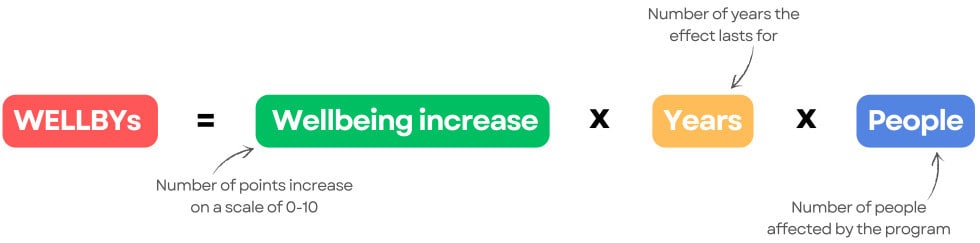
Best charities are hundreds of times better at increasing happiness per dollar.
As we show in the figure below, there’s a huge variation in the wellbeing you can buy per dollar donated across charities.
To put this in perspective, you’re as tall as the average person, and your height represents the cost-effectiveness of the least good charity on the list (this still has a positive impact), the charity on the top of the list would be 5x times taller than the Eiffel Tower!8
What’s driving the differences in impact across charities? The short answer is that most cost-effective charities are cheaply providing effective solutions to serious problems faced by people in low and middle-income countries (LMICs). Whereas the least cost-effective charities operate in high-income countries (HICs). It costs charities much more to provide the same service in high-income countries, and these may have smaller impacts because the need is less and better met by existing services. We discuss this, and caveats, more in the chapter itself.
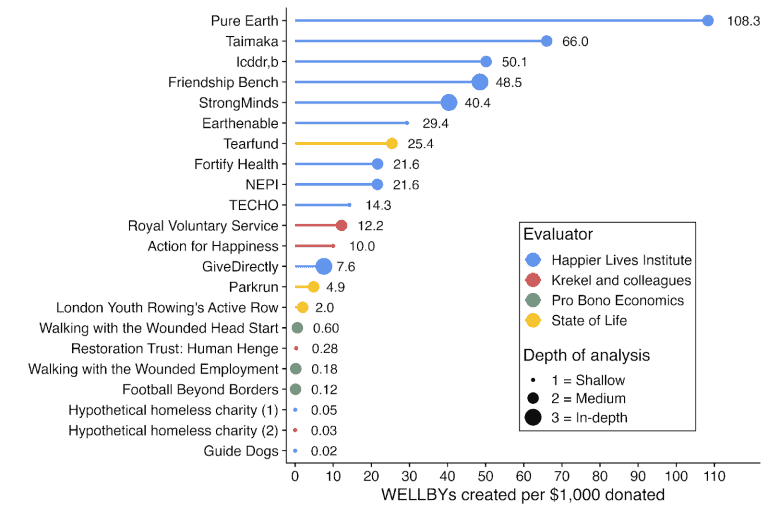
Note that our task was to bring together all the work that had already been done. All the research had the same output (WELLBYs per dollar) but the inputs were ‘lumpy’: some analyses were much deeper than others. It was out of scope to re-analyse and update all the pre-existing estimates. So take this as the first word on the topic, not the last!
What are the most cost-effective charities identified so far?
The most cost-effective charities found so far focus on mental health, malnutrition, and lead exposure reduction in low-income countries:
Pure Earth (Lead Exposure Reduction)
- Cost per WELLBY: $9
- Advocacy efforts to reduce lead poisoning, improving health and cognitive function.
Taimaka (Malnutrition Treatment)
- Cost per WELLBY: $15
- Delivers life-saving therapeutic food to treat acute malnutrition in Nigeria.
- Cost per WELLBY: $21–$25
- Both charities provide low-cost, scalable mental health support in sub-Saharan Africa where the need is great but there is very little provision.
We recognise that “Dollars per WELLBY” is not very intuitive. To get a feel for what this means, consider that $20 will, for many, be the cost of a meal out. If you know of a restaurant that will raise your happiness by 1-point for a whole year – more than the difference between being employed and unemployed – then let us know so we can go there! By supporting the best charities, we can make an incredible difference to others at a very small cost to ourselves.
Why aren’t there any charities I’ve heard of at the top of the list?
In writing the chapter, what stood out as a gap in the current research is that it didn’t include any well-known charities. We wanted to add some estimates of well-known charities, but we found it surprisingly hard.
Why? Lots of big charities are what we call ‘MANGOs’, standing for ‘Multi-Armed NGOs’. For instance, Oxfam runs hundreds of different programmes. In the chapter, we explain the ‘MANGO problem’ is that it is effectively impossible for us to assess these sorts of organisations. So, donors are really guessing about how much good their money does.
Well-known charities don’t necessarily have a big impact, even if they do more or less one thing. For instance, we did a quick estimation of the cost-effectiveness of Guide Dogs UK, not because we want to pick on them, but simply because they were one prominent charity that was easier to assess. We estimate that Guide Dogs UK produces a WELLBY for ~$41,000 (i.e., ~2,200 less cost-effective than the average of the top 5 charities, see below). Even though Guide dogs do have a huge impact on the lives of their beneficiaries, training each guide dog costs around $200k9, making it less cost-effective than other charities that have the same impact for fewer costs.
We did quick cost-effectiveness analyses based on studies of housing (~$35,000 per WELLBY) and cash (~$20,000 per WELLBY) interventions to aid the homeless. These came in at ~2,000 less cost-effective than the top 5 charities, indicating it’s very, very hard to help the homeless cost-effectively.
Fund the best charities and centuplicate (or more) your impact at no extra cost!
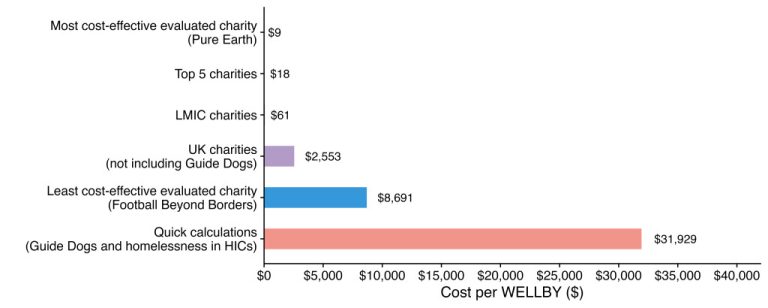
If we compare the top 5 charities in our sample to the average of the UK charities (not including Guide Dogs), the top 5 are ~150 times better (142 times to be precise). The implication is that donating $1,000 to a top charity can have the same impact as donating ~$150,000 to a more typical one. We think the UK charities are more representative of ‘typical charities’, at least for people living in high-income countries, as few donations go overseas (between 5% and 15%).
The most cost-effective charity in the analysis (Pure Earth) is ~300 times better (277 times to be precise) at increasing happiness than the average of UK charities and ~1,000 times better (942 times to be precise) at increasing happiness than the least effective evaluated charity (Football Beyond Borders).
But all the charities in our sample had chosen to be evaluated by researchers, so they are probably much better than average. When compared to the average of our quick analyses of Guide Dogs and helping the homeless, the best charity is ~3,500 times better than these popular destinations for our charitable dollars.
Does this mean I have to give? Our resident moral philosopher (Dr. Michael Plant, HLI Director) addresses these questions and more about charitable giving:
- Do I have to give? You may not be obligated to give, but you should, if you can. However, if you do decide to give, many have the intuition that we should make a bigger, rather than smaller, difference.
- How much should I give? The largest amount that you can sustain. A good benchmark is 1% for those earning $40k-$80k, is 5% between $80k-$120k, rising to 50% for those earning over $50m.
- Will giving make me happier? Yes. Indeed, in the opening chapter of the World Happiness Report, they estimate that people who donate tend to get greater improvements in happiness than those performing other benevolent acts such as helping strangers or volunteering. But if you’re not sure if giving will make you happier, you can always try it out!
- I already give to charity – is it wrong for me to switch to something that would help more? No, not if the point is to help others. But if it makes it easier, consider giving to both the best charities and the ones closest to your heart.
See our full chapter for more advice.
You can do a lot of good, maybe more than you imagined.
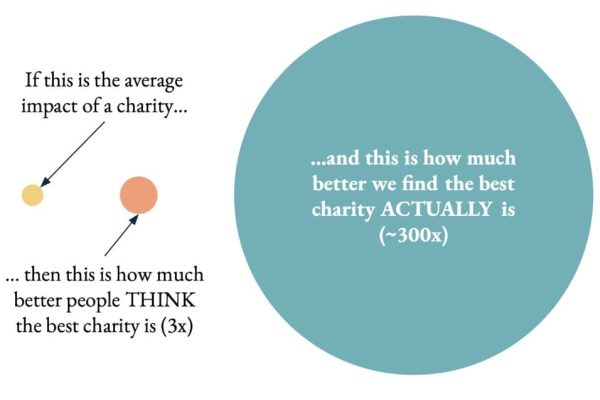
Most people think the best charity to help the global poor is around 3x as good as the typical charity.
Based on the evidence we’ve presented, we think the difference between the best and the rest of charities is much, much larger (coarsely illustrated here). We’re not the only ones who think that – other experts on evaluating charities agree.
Before this recent innovation to evaluate charities in terms of wellbeing – using a standardised, scientific approach, that captures what really matters – it was very hard to compare charities or know how much impact you were having. And, if we’re allowed to toot our own horn, before our analysis in the World Happiness Report, there wasn’t much hard evidence of how big the differences in charity impact were, per dollar.
But these developments, and what we’ve found, gives us heart. The world feels full of problems that we can do nothing about. But it turns out that we can do something and feel confident we’re making a difference: we can (now) capture charity’s impacts on happiness. What’s more, because impact varies so much between charities, this means we can have a huge, and vastly greater impact, at no extra cost to ourselves – simply by following the evidence and supporting the best charities found so far.

What You Can Do Today
Give today! Learn how YOU can improve someone’s life RIGHT NOW with your generous donation.
Support our research so that we can continue finding the best opportunities for improving lives across the world.
Read the complete analysis and more in our chapter of the World Happiness Report 2025. For even more detail you can see the appendix.

For Media
If you work in the media, check out our press release. Please share these findings and get in touch.

For Policymakers
Use WELLBYs to design and evaluate public programs that maximise societal wellbeing. For more, see this recent research from the London School of Economics.

For Researchers
The best may be yet to come. We need much more research into wellbeing cost-effectiveness. Wellbeing cost-effectiveness is an unusual area where barely any work has been done and it has huge, direct practical implications. We hope researchers take up the challenge and use their skills to make a difference.

For Foundations
Focus on funding interventions with the greatest potential to transform lives. We now offer research consultancy services, so get in touch if you’re after tailored research to maximise your impact.
What’s Next for the Happier Lives Institute?