

People say ‘money can’t buy happiness’. Other people offer the reply that “the people who say ‘money can’t buy happiness’ just don’t know where to shop”.
Our response is that money definitely can buy happiness. We think that’s so obvious it’s a boring question to ask. A better question is “how much happiness can money buy?”. An even better question is “how do I buy the most happiness for my money?” We will answer each of these in turn.
YES, money can buy happiness.
In a summary of 45 causal studies, some co-authors and I found that when you give people living in low and middle income countries a cash transfer, it makes them happier and it does so for a long time. This shows that money can buy some people happiness. This focus on causal studies – which rely on the same sort of methods used in medicine for test drugs – is important. This is because lots of studies of money and happiness are correlation and, as you’ve probably heard a million times, correlation does not imply causation. The correlation research leaves open the possibility that happier people get richer and that richer people get happier.
Money can buy happiness in low and middle income countries
We’ve published many papers on cash transfers including:
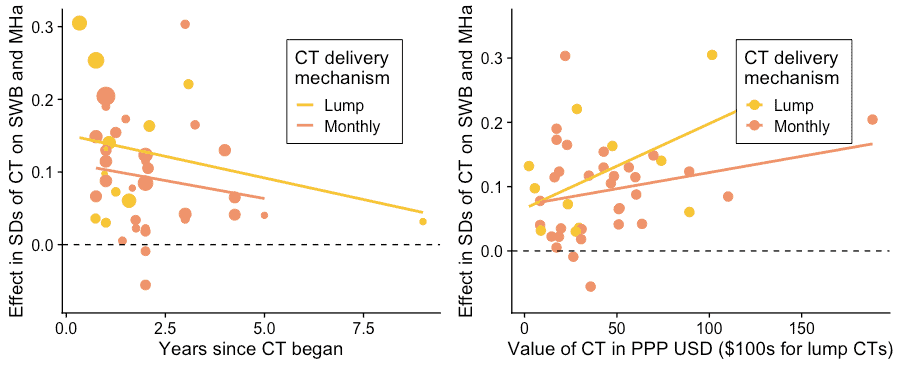
CT = cash transfer, SD = standard deviation, SWB = subjective wellbeing, MH = mental health, PPP = purchasing power parity. These graphs show the effect of cash transfers on individuals’ wellbeing and mental health in an effort to understand if money can buy happiness.
Can money buy happiness in rich countries?
However, I think what most people have in mind when they say “money doesn’t buy happiness” is they’re thinking about those that already seem to have enough to satisfy their basic needs. They are thinking about other people in rich countries, not the global poor. So can money buy happiness for people in rich countries.. Let’s turn to that now.
How much happiness can money buy?
In a famous paper published in a top psychology journal 2010, by two Nobel laureates the psychologist Daniel Kahneman and economist Angus Deaton found that:
“beyond about $75,000/y, there is no improvement whatever in any of the three measures of emotional well-being.”
This is the origin of the claim, one you’ve very probably heard, that people don’t get happier after $75k (which would be ~$110k in current dollars). But they also look at life satisfaction and find no obvious satiation point. We’ll challenge this finding in a moment, but what it’s claiming is that if you earn more than $75k you won’t feel any happier day by day, but you may still be happier about your life.

The debate on how much money can happiness buy
This spurred a considerable amount of debate in economics, given that in the profession we are taught to assume that more money = more happiness because it means we have options, and more options is always better. I’ll leave it as an exercise to the reader to find the flaws in that line of reasoning.
The next episode in the debate was a 2013 paper published in the top economics journal by the economists and power couple (they are married) Stevens and Wolfers whose abstract ends in what equates to a mic drop by nerds:
“Many scholars have argued that once “basic needs” have been met, further rises in income are not associated with further increases in subjective well-being. […] we find no support for this claim. The relationship between well-being and income […] does not diminish as incomes rise. If there is a satiation point, we are yet to reach it.” [Emphasis mine, (boom)]
But that wasn’t the end of it. In 2018 a paper, using fancy methods, a team of psychologists rejoined by claiming to have found that we need even less money to be happy.
“Globally, we find that satiation occurs at $95,000 for life evaluation and $60,000 to $75,000 for emotional well-being.”
Indeed, the debate continued with Killingsworth publishing a paper in 2021, using an unusually large dataset with a more accurate measure of emotional experience, found that:
“There was no evidence for an experienced well-being plateau above $75,000/y, contrary to some influential past research.”
The figure he presents looks remarkably different from the original.

Results of how much happiness can money buy debate
The eagle-eyed among you will have noticed the x-axis is a bit zany, as the numbers keep doubling (it’s a ‘logarithmic scale’). While we don’t have a stake in this debate, it’s worth pointing out that when you take their data and replot it to have a normal x-axis the data looks way more plateau-y, especially for emotional wellbeing.

Money can buy you more happiness if you’re already happy
The debate came to a surprising conclusion, at least amongst two of its key participants3: Daniel Kahneman and Matthew Killingsworth. In a practice unusual in science, but regarded as a good thing for scientists to do, they embarked on an ‘adversarial collaboration’, where they worked together to try and hash out exactly why they disagreed. In 2022 they published a paper together saying they were both right – and wrong.
It seems like Kahneman conceded a bit more, to Killingsworth’s methods and data, and overall claim that there’s no satiation point on average. Together they found that there is still a satiation point, but only for those who were initially not very happy to begin with. So, the head-twisting conclusion is that money can buy you more happiness if you’re already happy. But, if you’re miserable to start with, money will only do so much.
The profound takeaway: if you want to be happy, don’t be unhappy.
Okay, maybe that’s not the most useful advice. In the next article, we’ll tackle how to buy more happiness for your money.
Your money can buy happiness for others
Donate to the most cost-effective charities at creating happiness. We have done the research so you don’t have to. Consider donating to us for our work.