

Lead exposure doesn’t often make headlines, but it’s quietly damaging the brains and bodies of 1 in 3 children globally. And despite the scale of harm, efforts to address it are shockingly underfunded.
Pure Earth: The best charity we’ve found yet
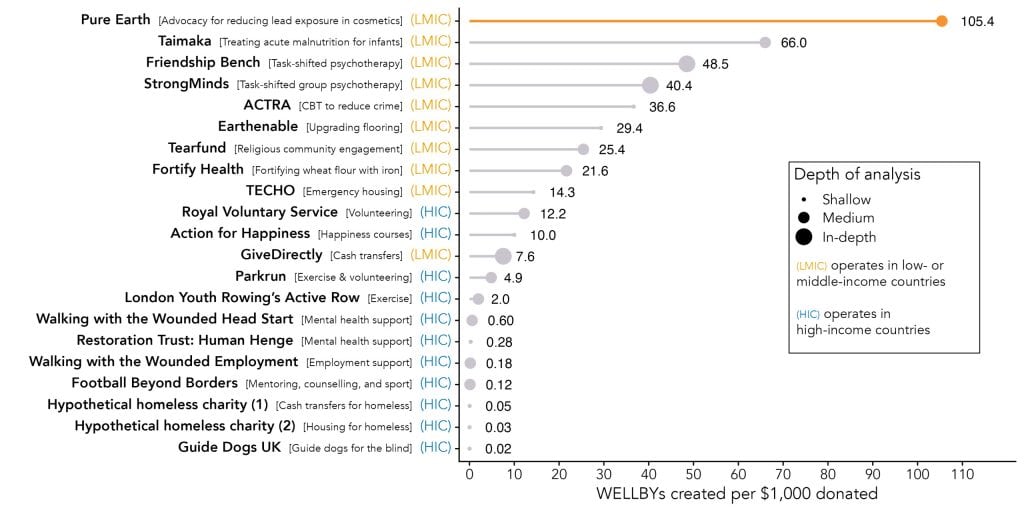
As outlined in our recent chapter in the World Happiness Report, we measure charitable impact in WELLBYs and have found Pure Earth to be the most cost-effective charity at increasing happiness.
- Lead exposure is a widespread problem that’s received a minuscule amount of support.
- The problem isn’t just large, it’s important. Lead exposure can permanently and irreparably harm the lives of the children it affects.
- Pure Earth is finding lean, innovative and sustainable solutions to reducing lead exposure. We are especially excited by their programmes to remove lead from cosmetics – one of which we’ve evaluated and which we encourage you to fund.
Note that there are some caveats to our analysis, which we present at the end of this blog.
Why lead is a blight on humanity
You probably know that lead is bad. You might have even heard tales about how lead in Rome’s water hastened the Empire’s collapse or that lead exposure fueled the historic crime wave America saw in the latter half of the 20th century. While those stories oversimplify, lead carries with it a sense that it’s part of history, a problem of the past.
This simply isn’t true.
What products is lead added to?
While one the largest sources of exposure to lead, leaded gasoline, was phased out of most rich countries by 2000 (starting with Japan in 1986 and most recently Algeria in 2021), lead is still present in many products, especially in lower-income countries.
For example, high-income countries have removed lead from paint and batteries, but these are still very much problems in lower-income countries.
Other products which still commonly contain lead in lower-income countries may surprise you: such as spices (leaded chromate is added to make the colour of turmeric pop), cosmetics (for some eyeliner applied to children, one of the main ingredients is finely ground lead ore), and ceramics (which makes for a glossy surface).
The persistence of lead means there are about 815 million children in the world with dangerously high levels of lead according to Pure Earth and UNICEF.
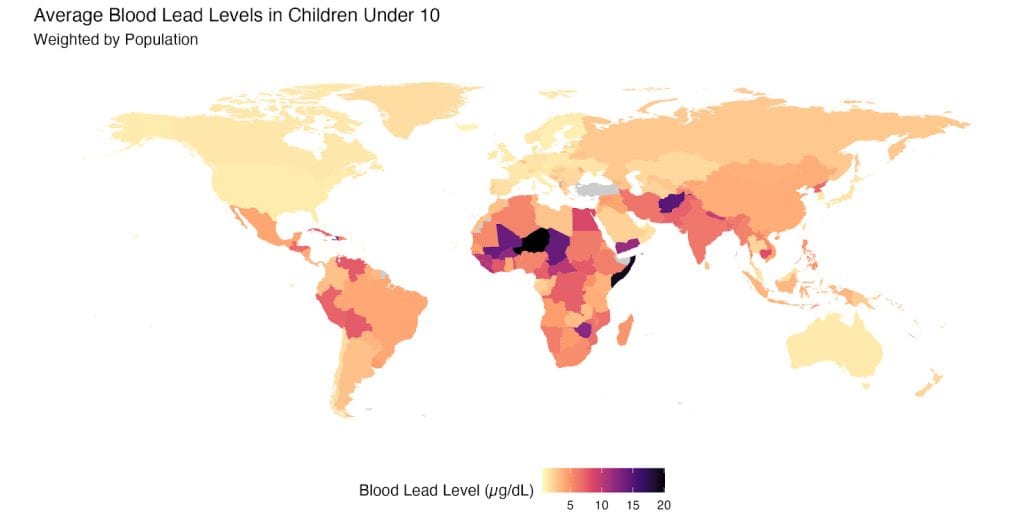
Note. Lead exposure is measured in micrograms of lead per blood deciliter (µg/dL) and according to the WHO “there is no known safe blood lead concentration; even blood lead concentrations as low as 3.5 µg/dL may be associated with decreased intelligence in children, behavioural difficulties and learning problems”.
Blood lead levels are from the latest IHME data in 2021. Because the results from the IHME are split across different age groups, we weight them according to population size for each age group (UN Population Division). Grey countries do not have data.
What damage can lead exposure cause to humans?
Lead exposure in childhood has been linked to many adverse outcomes (see a summary in our report):
- Reduced IQ and cognitive functioning
- Worse schooling outcomes and lower income
- Emotional and behavioural issues such as higher rates of ADHD, impulsivity, neuroticism, lower conscientiousness, depression and anxiety
- Higher rates of crime and antisocial behaviour
- Cardiovascular diseases
- Kidney diseases
It should come as no surprise that this means lead is a permanent and profound source of suffering.
Pure Earth’s project: Tackling cosmetics in Ghana
Though Pure Earth runs a number of projects we investigated just one of them, which targets lead exposure in cosmetics in Ghana.
In Ghana, a large share of lead exposure often comes from cosmetics. For example, traditional eyeliner known as Chilo (or Khol) commonly contains extremely high levels of lead. Early research suggests that use is high in Ghana, particularly in the north where 93% of children reportedly have Chilo applied.
And by “extremely high levels” it’s worth emphasising that Chilo or Khol’s primary ingredient is ground-up galena, a mineral mainly composed of lead sulfide. So yes, the toxic substance that is harmful even in tiny substances is the primary ingredient of a product that’s regularly put on children’s faces (regardless of gender), even infants. We can find few things that require less justification for their badness.
Some of this lead will be absorbed through the skin, and some will be ingested via hand-to-mouth contact. These products remain widely used because communities aren’t fully aware of the dangers.
Thankfully, safer, affordable alternatives already exist, making this an imminently solvable problem. One that Pure Earth has shown itself capable of resolving.
Pure Earth’s strategy is a combination of educating officials and communities about the dangers of lead exposure, collaborating with the government to draft and enforce strict regulations, and supporting lead-free cosmetics into the market.
Our analysis: why clean cosmetics are incredibly cost-effective at increasing wellbeing
We estimated that Pure Earth’s project will have a relatively small effect per person, but it could affect a huge number (over 9.1 million children), creating an astonishing 226,702 WELLBYs (wait, what is a WELLBY?) for a small cost of around $2 million.
This implies a cost-effectiveness of just over 105 WELLBYs created per $1000 donated or around $9 per WELLBY.
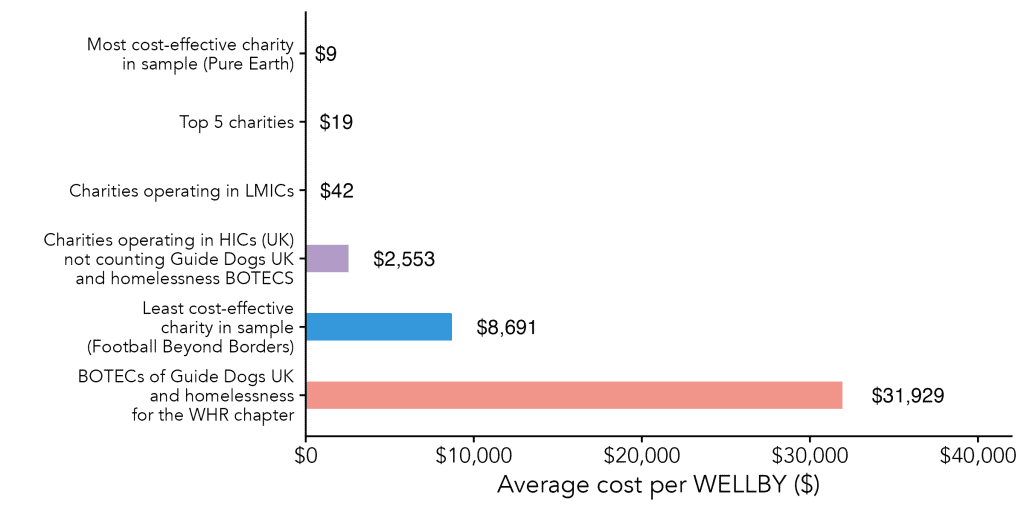
This astounding price per WELLBY means Pure Earth isn’t just cost-effective – it’s off the charts (well, almost). We estimate that every $100 donated to Pure Earth creates as much wellbeing as a $27,700 donation to a typical UK charity. In other words, your donation could go 277 times further in improving lives!
So ask yourself: does someone’s birthplace change how much you value their happiness? If not, this is an amazing opportunity to have an outsized impact on an enormous number of children. Pure Earth still has a $1.6 million funding gap for this project – and right now, there’s real momentum in Ghana to reform lead policy. With your funding, they have a good shot at turning that momentum into lasting change.
Read our full report for more details.
The limits of our analysis
Despite Pure Earth topping our list of charities based on cost-effectiveness, we have classed it as a ‘promising charity’, not a ‘top charity’. Promising charities have more uncertainties in their estimate, making them well-suited for donors who are seeking the highest rates of return and happy with a higher level of risk. Think of this as investing in a start-up, not government bonds.
Our uncertainty in our Pure Earth estimate is due in part to a limited amount of evidence to draw upon (three correlational studies). While a limitation, this is also an opportunity – we strongly encourage future research into the causal wellbeing effects of lead exposure in childhood.
This said our evaluation used conservative modelling choices, assumptions and discounts throughout our analysis, and the cost-effectiveness still turned out higher than any other charity we have reviewed.
It’s worth noting that Pure Earth carries out dozens of other projects ranging from removing lead from spices to remediating toxic waste sites. While we are optimistic about the impact of these broader projects, we haven’t evaluated them so we are most confident in supporting their cosmetic’s project in Ghana which we’ve analysed and which you can directly give to via our website.
How you can help
If you want to support Pure Earth or our work you can take action today by:
- Donating to Pure Earth: You can donate to Pure Earth through our website. We advise giving through us as we can ensure donations are funnelled exclusively to their cosmetics programme rather than any of Pure Earth’s unevaluated programmes.
- Donating to the Happier Lives Institute: Our research costs time and money! If you want to support the Happier Lives Institute to keep shining the spotlight on fantastic charities, and support us to do a deeper dive on Pure Earth you can donate directly to us.
- Learning more: Read our detailed evaluation of Pure Earth and our World Happiness Report chapter.
- Staying informed: Sign up for our newsletter to receive updates and insights into effective giving opportunities.
- Spreading the word: Bring our work up at the dinner table tonight! Or maybe the next time you are at the pub with friends, talk to them about Pure Earth. This is the cheapest and most effective way to help us raise awareness and support for the crucial work of Pure Earth and other fantastic charities.
Your decision today could change thousands of lives for the better.