

What is a year of depression avoided?
Summary
We estimate that our Top Charities prevent the equivalent of a year of depression for about ~$29 (~$16 for our promising charities, and ~$21 over all our recommendations)To average, because these are ratios, we use the geometric mean., and ‘save a life from suffering’ for about $2,000. This document explains how we came up with these figures, what we mean by ‘saving a life from suffering’, and what the cost of a Year of Depression Averted (YODA) is for our different evaluations. The starting point for this is that the data indicates having depression is associated with about -1.3 points on a 0-10 life satisfaction scale; this means 1 WELLBY has roughly an impact equivalent to preventing 9 months of depression for someone.
0. Why are we using depression-years and -lifetimes as a benchmark?
The Happier Lives Institute presents impacts in WELLBYs (see here or Frijters et al., 2024), which is a 1-point change over 1 year on a 0-10 wellbeing scale. WELLBYs allow us to compare different things, such as poverty, health, and relationships, in a common unit. However, we also realise that it is hard to get an intuitive feel for the impact of ‘1 WELLBY ’, so we have started explaining the cost-effectiveness of our recommended charities in two other ways: (1) the cost to prevent a year of depression and (2) the cost to ‘save a life from suffering’, based on preventing a lifetime’s worth of depression.
The idea is to benchmark a WELLBY against events that are common, understandable, and have clear and sizable wellbeing impacts. We could also say that 1 WELLBY is about the effect of averting two years of unemployment, or a year of grief after the death of a loved one. But we think depression is a more useful comparison. It is something most people have experienced directly or someone they know closely has experienced at some point in their lives, and many of our charities address mental health directly.
For instance, we estimate our Top Charities, StrongMinds and Friendship Bench, have a cost per WELLBY of around $23. Put differently, each $23 donated has an impact equivalent to preventing around a year (~9 months) of depression for someone. We think this is a more intuitive way of explaining the impact donations have than using cost per WELLBYs or the alternatives we have previously used, namely saying they are 44 WELLBYs/$1,000 or about 5x cash transfers.
This point about value-for-money is sharpened by adding that we have previously estimated that typical charities in rich countries have about 1/1000th the impact per dollar as the best charities, as measured in WELLBYs. So, we can say you need to donate about $25,000 to a typical charity to almost prevent a year of depression. (These estimates come from the global comparison of charities we first published in the 2025 World Happiness Report.)
Finally, because many donors think in terms of the cost to save a life, we could also say that it costs the Top Charities about 60 years * $29 per year of depression averted = $1,740 to prevent the equivalent of a lifetime of depression-years, which we think is reasonably framed as ‘saving a life from suffering’. We elaborate on this further below.
1. Where the WELLBY loss from depression figure comes from
The depression figure we typically use is from the Happiness Research Institute’s (2020) analysis of the Survey of Health, Ageing, and Retirement in Europe (SHARE) from 2005 to 2017, which includes roughly 110,000 European adults (45+) from 2006 to 2017 for a total of 250,000 observations. This analysis finds that depression is associated with a -1.3 decline in life satisfaction. The HRI study is the most easily citable figure, since the relationship between the two variables is rarely the object of analysis.
2. Is this number credible?
We believe the HRI figure is reasonable as an estimate of the binary association between depression and wellbeing. We find a similar magnitude figure (-1.4) after averaging across estimates from 12 international datasets and studies (see here).
One objection we anticipate is that this is the association; what about the causal impact of depression on subjective wellbeing? We do not think it is possible to analyse the effect of depression on subjective wellbeing because we expect that anything that causes depression will simultaneously affect subjective wellbeingWe are matching an intensity of felt experience to the state of health that doctors attach the label 'depression' to. The relevant relationship is not between SWB scales and depression scales.. This is because mental health related to depression and wellbeing are very similar constructs, both being deeply defined by the quality of one’s mood and experiences.
Another objection we imagine is: “Isn’t this too low? Depression seems like one of the worst things that can happen to someone, but is it really equivalent to going from an 8 → 6.7 on a wellbeing scale?” We sympathise with this intuition, but several points reassure us.
First, these are the largest coefficients you can find. It is incredibly rare to find a coefficient for a single variable that suggests an effect of over 1 point on a 0 to 10 wellbeing scaleDoes this mean there’s something fundamentally wrong with SWB that there is nothing with a larger effect than 1 point? No, I think SWB and MH are good but not perfect measures – they’re still moderately noisily measured, meaning that classical measurement error will push coefficients towards zero.
. The only other variable we have found with a similar magnitude is loneliness (Seifert, 2024) or extreme pain (Stewart et al., 2026; HRI, 2020), both of which have effects of around 1 point on a wellbeing scale. If we think 2.5 or 5/10 on a life satisfaction(/happiness) scale (Dupret and Plant, 2026) is the tipping point at which you go from satisfied to dissatisfied (/happy to unhappy), and people in rich countries are often around 7/10 on these scales, then going from 7 to 5.7 takes you about 1/3rd to 2/3rd the way from your current life to an overall negative one, i.e. a 1/3rds to 2/3rds loss in how good your life is.Second, these “small” wellbeing effects typically represent the effect of going from mild symptoms of depression to moderate symptoms of depression. This is a natural consequence of categorising a unimodal distribution and discretising what is ultimately continuous. If it were the case that ‘mentally well’ meant a cluster of scores that showed zero symptoms of distress, and ‘depressed’ was another cluster that all showed very severe symptoms, that would be a different story. However, that is not the nature of depression. This misconception seems to plausibly stem from the inclination by clinicians, the DSM, and, perhaps most importantly, insurers and medical providers to split everyone into depressed and not-depressed.
For instance, the difference between “distressed” and “not distressed” is around 10 points on the Kessler 10-item distress scale (a very common measure of general distress and depression) between the two populations below, despite the scale itself being around 4x wider in possible scores.
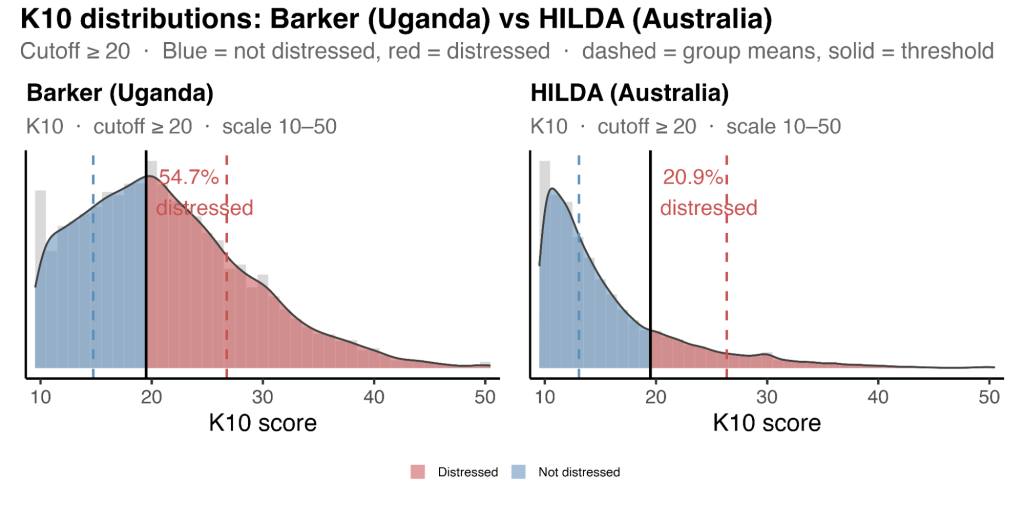
If we are ultimately asking what the effect is of going from the most to the least depressed? The effect is much larger. More like -2 to -5 points on a 0 to 10 wellbeing scale, depending on the sample. If you wanted to know what we would think is the wellbeing effect of a year of severe depression averted, it would probably be more like -3.5 WELLBYs. Which, depending on the estimate of the neutral point you choose (Dupret and Plant, 2026), would in the best case destroy ~80% of one's satisfaction or happiness, or push them into a life with wellbeing about as bad as a typical life in a Western country is good.
3. How we convert from depression-years to ‘saving a life from suffering’
Many donors are used to thinking about saving lives, and the cost per life saved. We have tried to present something analogous for wellbeing. The thought is simple: a year with depression is a year of substantial suffering, so preventing a lifetime's worth of depressed years is, in effect, equivalent to "saving a life from suffering." On this framing, our Top Charities save a life from suffering for around $2,000.
Audiences we have spoken to find this intuitive, but "save a life from suffering" is non-standard, so we want to explain the choice.
To be clear, we are speaking loosely. We mean preventing a lifetime's worth of suffering spread across many individuals, not preventing a whole life of suffering for one specific individual. Very few people are miserable their entire lives, and we know of no intervention that prevents a specific person from suffering their whole life.
Why not "saving someone from a life of depression"? People who live with depression are not depressed continuously; they have better and worse periods. We are talking about the equivalent of a lifetime made up entirely of acutely depressed periods, which is much worse than a typical "life spent with depression." The more technically accurate phrase would be "saving someone from a lifetime's worth of depressed years," but that is clunky and unintuitive.
Is "save a life from suffering" an abuse of "save a life"? In ordinary usage, "saving a life" usually means preventing a premature death. But even that is vague: you have technically saved a life if someone dies a minute later. The phrase is also used more broadly. If a friend helps you through a very difficult (but non-life-threatening) period, you might say they saved your life. Since donors who talk about saving lives often picture preventing premature deaths of young people in poor countries, we think "saving a life from suffering" should refer to a roughly comparable stretch of time. Life-saving interventions do not fully restore life expectancy at birth either. Bed nets, for instance, save many young children but also some older people, with an average beneficiary age of around 20. So to illustrate the cost of preventing a lifetime's worth of substantial suffering, we assume this means averting about 60 years of depression (worldwide life expectancy is around 73).
What does it mean to save a life from suffering? There are a few possible meanings, and it is worth being explicit about which one we are using.
The first is that you prevent a life from suffering overall, meaning it goes from net negative to net positive in wellbeing. On this definition, the amount of suffering you have to prevent varies hugely between people: making a very slightly unhappy person happy would count, but relieving a huge amount of suffering from an already miserable person would not. It also has awkward edge cases, like nudging someone from -0.001 to +0.001 WELLBYs per year. This seems unhelpful. The second is that you prevent a life from having any suffering at all. However, this is practically impossible, since even the best lives contain some suffering, so it is not useful either. The third is that you prevent a substantial amount of suffering in a life. This seems right, because it rules out cases like claiming you have saved a life from suffering by stopping someone from stubbing their toe. It does raise the question of what counts as substantial, and here we simply claim that whatever the bar is, depression must clear it, given that it is associated with one of the largest losses of wellbeing observed in the data.
4. Cost-effectiveness in years and lifetimes of depression averted for charities
Assuming that 1 YODA = 1.3 WELLBYs (or the equivalent), then our cost-effectiveness in these terms is as follows:
Charity | Cost per WELLBY | Cost per YEAR of depression averted | Cost per LIFETIME of depression averted |
Pure Earth (Ghana) | $9.49 | $12.33 | $739.85 |
Taimaka | $15.15 | $19.70 | $1,181.82 |
Friendship Bench | $20.61 | $26.79 | $1,607.58 |
StrongMinds | $24.77 | $32.20 | $1,932.06 |
ACTRA | $27.29 | $35.48 | $2,128.62 |
Shamiri | $30.37 | $39.48 | $2,368.86 |
Fortify Health | $46.19 | $60.05 | $3,602.77 |
GiveDirectly | $132.40 | $172.12 |
*This is equivalent to what we refer to as the cost to save a life from (substantial) suffering.
5. Note: this is a communications device, NOT an exchange rate between depression scores and wellbeing scores we use in our analyses.
We set the conversion rate between changes in affective mental health and subjective wellbeing scores at 1:1, based on evidence that the ratio is approximately 1 when both outcomes are captured in the same study or meta-analysis (Dupret et al., 2025).
We do not think it is useful to re-engineer wellbeing analyses by estimating years of depression averted and applying the 1.3 wellbeing weight. A more reliable approach uses changes in the continuous mental health or wellbeing score directly. For example, Baranov et al. (2020) find a 17% reduction in depression rates after 7 years, implying 1.2 years of depression averted and a wellbeing benefit of 1.2 × 1.3 = 1.56 WELLBYs. This is smaller than our meta-analytic estimate of ~2 WELLBYs for similar interventions, but that does not mean our estimate is wrong – it is more reliable precisely because it uses continuous scores. Binary measures lose information: the 1.3 figure represents moving from moderate to mild depression, but recipients' score changes could be larger, reflecting shifts from severe to mild symptoms or wellbeing improvements beyond depression alleviation.