

Won’t somebody please think of the children?
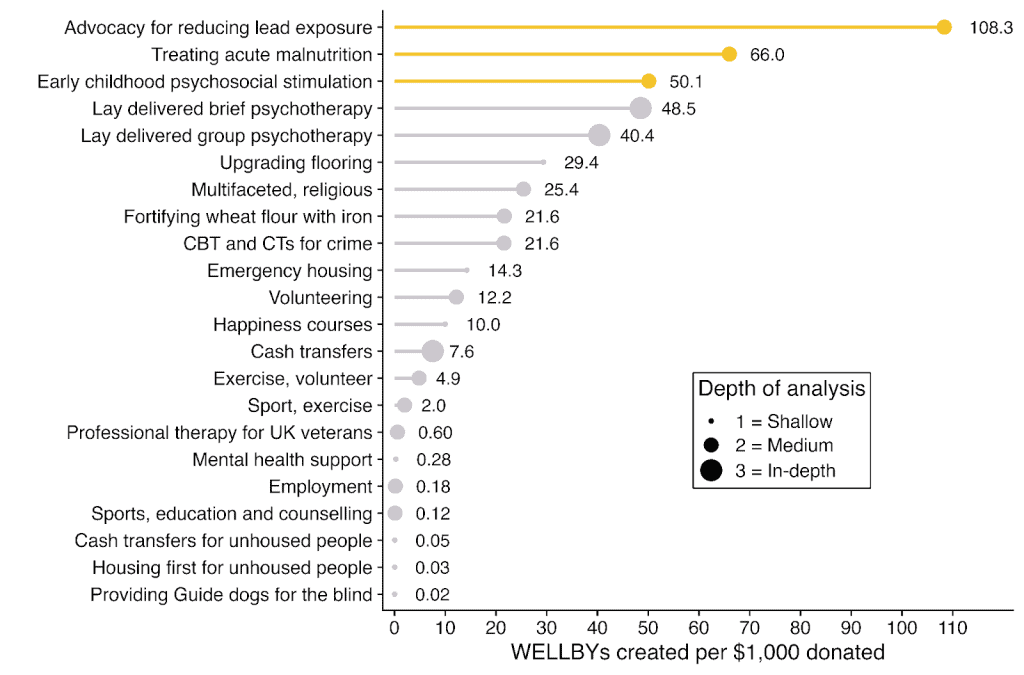
At the Happier Lives Institute, the highest impact interventions we’ve found so far share one thing in common. They focus on early life childhood interventions. The charities that deliver them are, indeed, thinking of the children.
See ‘what is a WELLBY?’ to understand how we measure the impact of charity’s programmes on a person’s wellbeing.
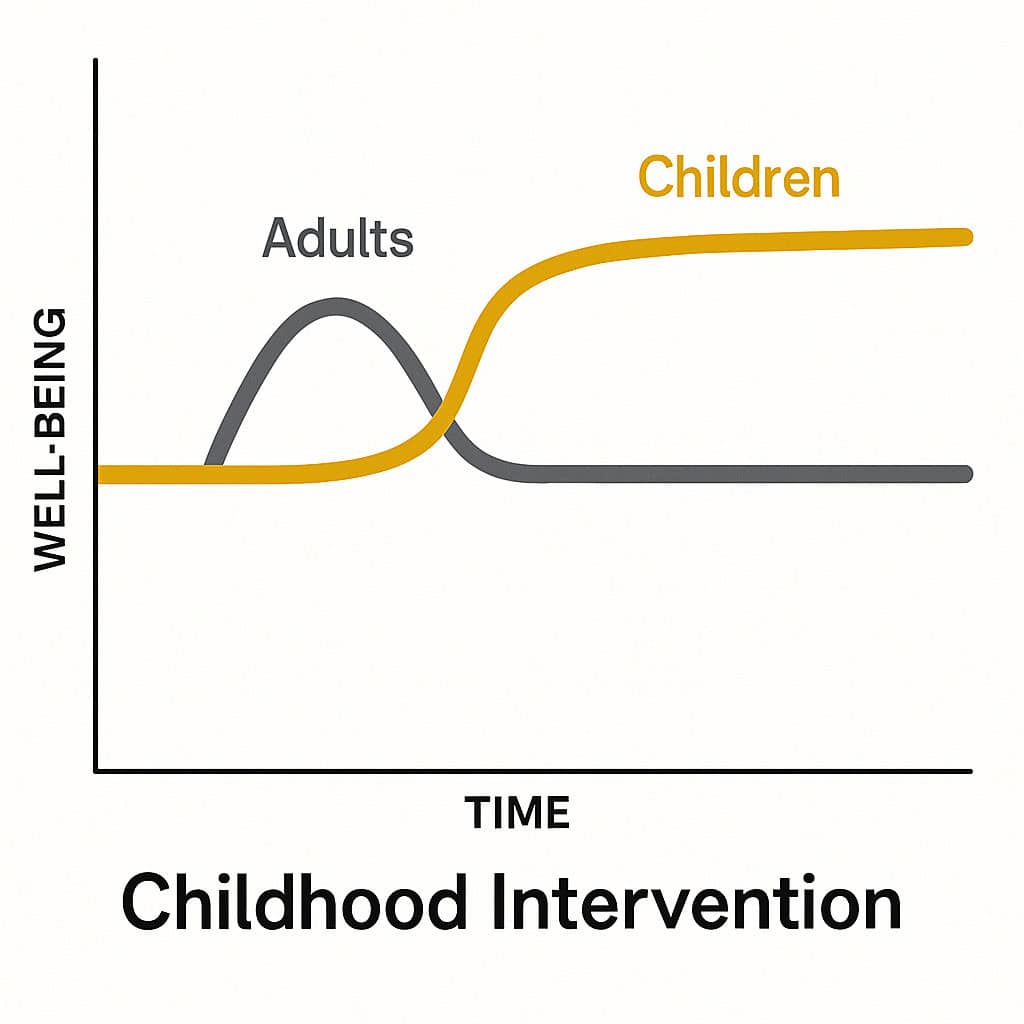
These interventions all share a common cause for their high impact: intervening early can lead to surprisingly long-lasting benefits!
This is for two reasons.
- Compared to adults, children have more of their lives to live. So any permanent benefit will last longer.
- The second reason is that children, compared to adults, may benefit more from being shielded from the same harm or given the same boost.
Number two stems from the idea that there are potentially sensitive periods in human development, where an event at one time of life exerts a greater influence than it would have had at another time. While applied to development in general, it also applies to mental wellbeing.
The cost-effective charities that create better childhoods
- Pure Earth. We’ve already discussed Pure Earth’s role in protecting children from lead exposure in Ghana (and many other places) in a recent blogpost, so we’ll be briefer here. Lead exposure in childhood is linked to lifelong declines in mental wellbeing, cognitive ability, as well as cardiovascular and kidney diseases.
In Ghana, Pure Earth provides technical support to the government to remove lead from common cosmetics, which make up a large share of lead exposure in the northern part of the country. One cosmetic that’s particularly high risk is an eyeliner (Chilo) applied to children where a common and primary ingredient is lead ore.
2. Taimaka is an impact-oriented organisation which treats malnutrition in northeastern Nigeria and is currently our second most cost-effective charity. Their approach adopts the gold standard method for treating malnutrition. It involves identifying severely underweight children, providing them with a nutrient-enriched peanut butter formula alongside basic medical care to prevent or treat infections (which malnourished children are especially susceptible to!).
Taimaka’s programme is well-run. Many other charities targeting malnutrition are Multi-Armed NGOs or ‘MANGOs’ as we call them. As we’ve argued, MANGOs are incredibly difficult to evaluate, and often mix good programmes with bad ones, making it hard to know if your funding has the highest impact.
Taimaka however, only has one programme and a small budget (in 2023 it was $328,231), so we can be confident that donations to Taimaka go to treating acute malnutrition and helping them reach economies of scale (which should make them even more cost-effective).
We think Taimaka’s work to treat acute malnutrition has a large and persistent effect because of the evidence of how other childhood nutritional interventions have had benefits into adulthood, or how exposure to famine in childhood could scar someone’s wellbeing well into old age.
See our full Taimaka report for many more details.
3. Improving parenting: the cause without a charity. The third most cost-effective intervention we’ve evaluated is a psychosocial stimulation programme for children.
Parent-based psychosocial stimulation interventions send community health workers to regularly visit and encourage parents to enrich their engagement with their children through simple activities like storytelling, playing, and avoiding harsh punishment.
The specific parenting intervention we’ve evaluated, the “Reach Up” intervention, has demonstrated in more than a dozen trials short-term improvements to child development outcomes (i.e., better language abilities). More impressively (but based on much slimmer evidence) there’s a single small trial suggesting that exposure to a Reach Up parenting programme as a child can improve wellbeing decades later. While that’s just one study, other natural experiments of early life childhood psychosocial stimulation reassure us that these long-lasting benefits are plausible. Reach our full report if you want us to walk you through the evidence.
While this programme is delivered by organisations like the icddr,b, we are yet to find and evaluate opportunities we can fund directly. We previously recommended the icddr,b’s programme when we thought we could fund it directly, but discontinued the recommendation when that became no longer true.
However, we still think our analysis suggests that the impact of effective parenting programmes is potentially very promising. In line with this, in the future we plan to evaluate organisations like Parenting for Lifelong Health, that primarily focus on delivering and scaling parenting interventions.
If you want to do more than merely *think* of the children
- Donate to Taimaka or Pure Earth: They can both still can usefully absorb hundreds of thousands of dollars of funding. For Pure Earth, if you want to ensure that your funds go directly to the Ghana programme we’ve evaluated, you need to donate through us and we’ll pass it along (no skimming off the top) through our fund set up just for this purpose.
- Support research and advocacy: Help the Happier Lives Institute identify effective and fundable parenting interventions.
- Stay informed or spread the word: Subscribe to our newsletter or share your favourite story of ours. Research finds that when people find out how much more you can do by giving to the best charities, they give more effectively!
Thinking of the children isn’t just compassionate, it’s one of the smartest, most effective ways to improve global wellbeing.